Association of MMP9 and NOS3 Polymorphisms with Distinct Clinical Forms of Juvenile Scleroderma and Characteristics of Humoral Immunity
Maria Osminina, Vera Podzolkova, Maria Litvinova, Natalia Geppe, Svetlana Chebysheva, Lusine Khachatryan, Natalia Golovanova, Yulia Kostina, Oksana Lazareva-Batyreva, Angelina Polyanskaya, Olga Shpitonkova, Tatiana Subbotina, Tigran Areian, Nadezhda Podchernyaeva

TL;DR
This study explores how genetic variations in MMP9 and NOS3 genes are linked to different types of juvenile scleroderma and immune system traits.
Contribution
The study identifies specific genetic polymorphisms associated with distinct clinical forms of juvenile scleroderma.
Findings
The MMP9 CT genotype is significantly associated with localized juvenile scleroderma.
The NOS3 GG genotype shows a trend toward association with systemic juvenile scleroderma.
The NOS3 GG genotype correlates with lower levels of anti-collagen IV antibodies.
Abstract
Juvenile scleroderma (JS), comprising localized (JLSd) and systemic (JSSc) forms, is a rare autoimmune disorder. This study investigated associations of polymorphisms in extracellular matrix (MMP1, MMP9) and vascular homeostasis (NOS3) genes with JS risk and immunological phenotypes. A case–control study involved 215JS patients (194 JLSd, 21 JSSc) and 72 controls. SNPs (MMP1 rs1799750, MMP9 rs3918242, NOS3 rs1799983) were genotyped using real-time PCR followed by minisequencing and mass spectrometric analysis of reaction products. Associations with disease risk, subtypes, and immunological markers were analyzed statistically. The MMP9 (rs3918242) CT genotype was significantly associated with JLSd (OR = 2.23, 95% CI: 1.14–4.37, p = 0.022), showing a trend in linear facial forms. The NOS3 (rs1799983) GG genotype demonstrated a trend toward association with JSSc (OR = 2.61, 95% CI:…
Genes, proteins, chemicals, diseases, species, mutations and cell lines named across the full text — each resolved to its canonical identifier and authoritative record.
Click any figure to enlarge with its caption.
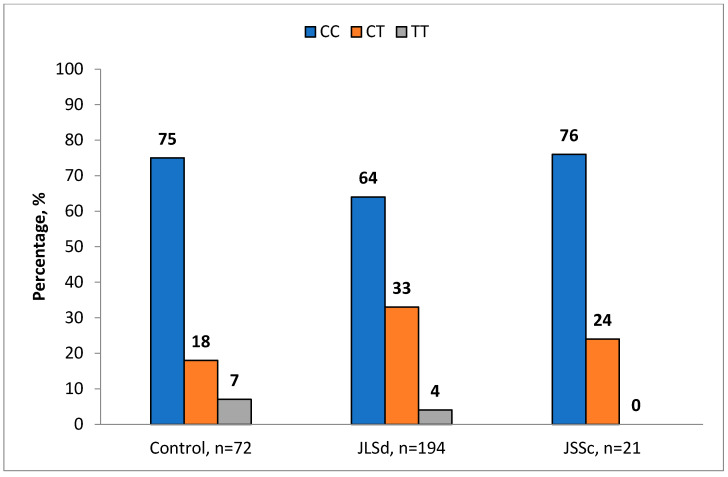 Figure 1
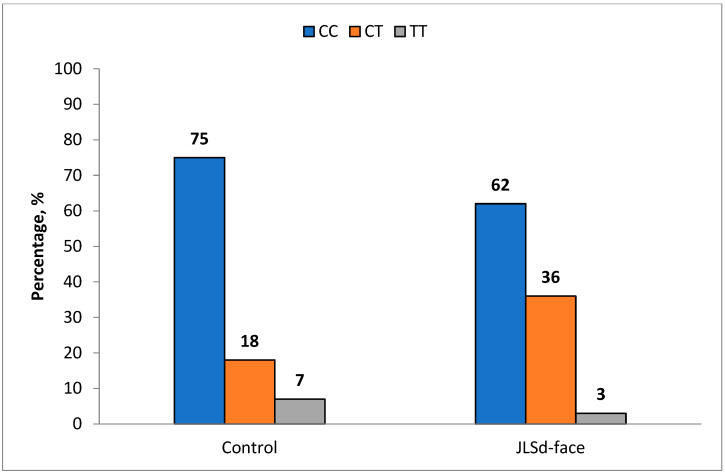 Figure 2
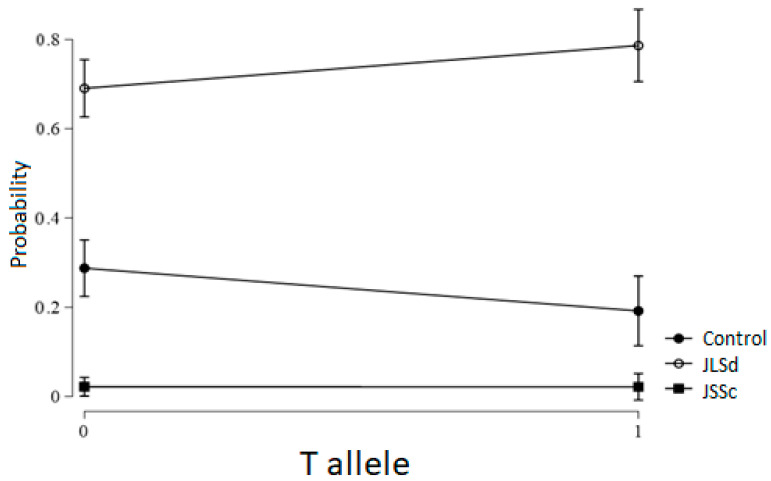 Figure 3
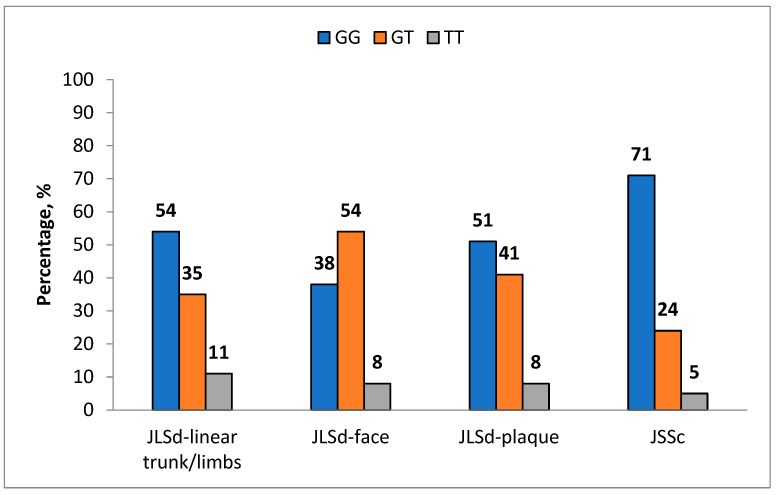 Figure 4
Peer Reviews
No public reviews on file for this paper yet. If you reviewed it on a platform where reviews are public (OpenReview, ICLR, NeurIPS, ICML), you can paste yours below so the community can read it here.
Videos
No videos yet. Explain this paper in a talk, walkthrough, or lecture? Add one.
Taxonomy
TopicsSystemic Sclerosis and Related Diseases · Connective Tissue Growth Factor Research · Vasculitis and related conditions