The Arrhythmogenic Spectrum of Mitral Valve Disease: Pathophysiology, Risk Stratification, and Surgical Management
Mariagrazia Piscione, Barbara Pala, Francesco Cribari, Walter Vignaroli, Jad Mroue, Vivek Mehta, Fadi Matar, Marco Alfonso Perrone

TL;DR
This paper explores how mitral valve disease can lead to dangerous heart rhythms and sudden cardiac death, focusing on structural changes and how they affect treatment decisions.
Contribution
The paper introduces a framework linking mitral valve prolapse, mitral annular disjunction, and arrhythmic vulnerability, emphasizing imaging and surgical implications.
Findings
Mitral annular disjunction is a key contributor to arrhythmic vulnerability in mitral valve prolapse.
Multimodality imaging improves the identification of arrhythmogenic substrates and guides surgical management.
Arrhythmias may persist after surgery in patients with fibrosis-based substrates.
Abstract
Mitral valve prolapse (MVP) is generally associated with excellent long-term outcomes when MR is absent or mild. Nonetheless, a small proportion of patients exhibit a distinct arrhythmogenic susceptibility, characterized by complex ventricular ectopy, sustained ventricular arrhythmias (VAs), and in rare instances, sudden cardiac death (SCD). This subgroup—collectively referred to as arrhythmic MVP (AMVP)—has prompted renewed attention in identifying individuals at elevated risk. Among the structural alterations associated with MVP, mitral annular disjunction (MAD) has gained recognition as a major contributor to arrhythmic vulnerability, arising from the pathological separation of the posterior annulus from the adjacent ventricular muscle. Advances in multimodality imaging, including trans-thoracic echocardiography (TTE), cardiac magnetic resonance (CMR), and cardiac computed tomography…
Genes, proteins, chemicals, diseases, species, mutations and cell lines named across the full text — each resolved to its canonical identifier and authoritative record.
Click any figure to enlarge with its caption.
 Figure 1
 Figure 2
 Figure 3
 Figure 4
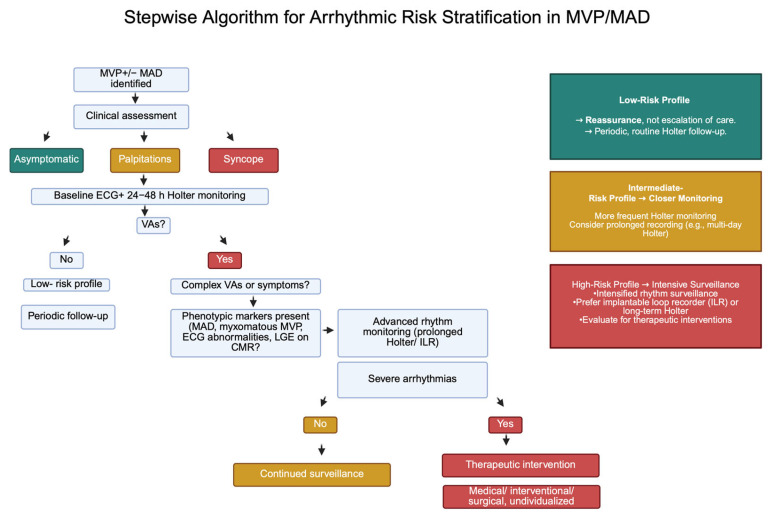 Figure 5
Peer Reviews
No public reviews on file for this paper yet. If you reviewed it on a platform where reviews are public (OpenReview, ICLR, NeurIPS, ICML), you can paste yours below so the community can read it here.
Videos
No videos yet. Explain this paper in a talk, walkthrough, or lecture? Add one.
Taxonomy
TopicsCardiac Valve Diseases and Treatments · Cardiovascular Function and Risk Factors · Cardiac Structural Anomalies and Repair