The Lacewings Micromus angulatus and Chrysoperla carnea as Predators of the Rhododendron Aphid, Illinoia lambersi, Under Different Temperature Regimes
Marie Froyen, Robin Beckx, Ellen Peeters, Wan-Yi Liao, Joachim Audenaert, Ruth Verhoeven, Alberto Pozzebon, Bruno Gobin, Patrick De Clercq

TL;DR
This study compares the effectiveness of two lacewing species in controlling a harmful aphid pest on rhododendrons under different temperatures.
Contribution
The study identifies Micromus angulatus as a promising biological control agent for Illinoia lambersi, especially under cool spring conditions.
Findings
Micromus angulatus larvae and adults effectively reduced aphid numbers across all tested temperatures.
Female M. angulatus adults were more effective predators than males and maintained consistent predation rates at different temperatures.
M. angulatus third instar larvae outperformed C. carnea larvae at 15 and 25 °C, and matched them at 20 °C.
Abstract
The aphid Illinoia lambersi is a key pest of Rhododendron in Northwestern Europe, causing leaf deformation, reduced flowering, and overall loss of plant quality. To support the development of pesticide-reducing strategies, we evaluated the potential of the brown lacewing Micromus angulatus as a biological control agent against this aphid. In laboratory tests, we quantified the predation capacity of M. angulatus larvae and adults at temperatures typical of spring and summer growing conditions (15, 20 and 25 °C), and compared their performance with that of larvae of the widely used green lacewing Chrysoperla carnea. Brown lacewing larvae of the third instar, as well as male and female adults of M. angulatus, consistently reduced aphid numbers across all tested temperatures. At 15 °C, its third-instar larvae performed similarly to those of C. carnea, whereas at 20 °C the green lacewing…
Genes, proteins, chemicals, diseases, species, mutations and cell lines named across the full text — each resolved to its canonical identifier and authoritative record.
Click any figure to enlarge with its caption.
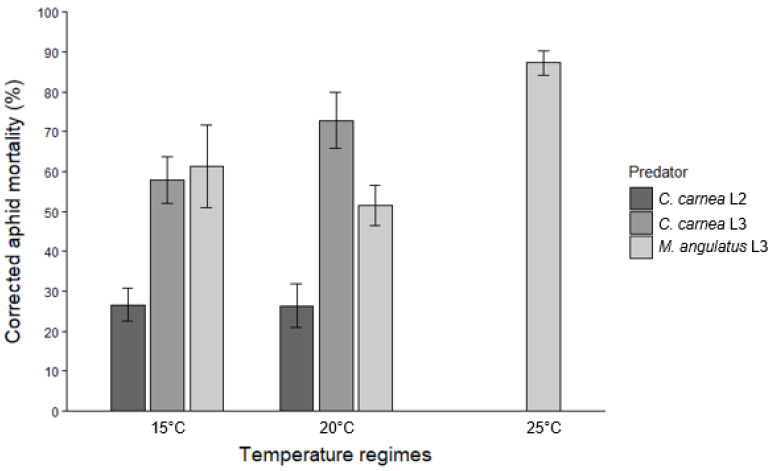 Figure 1
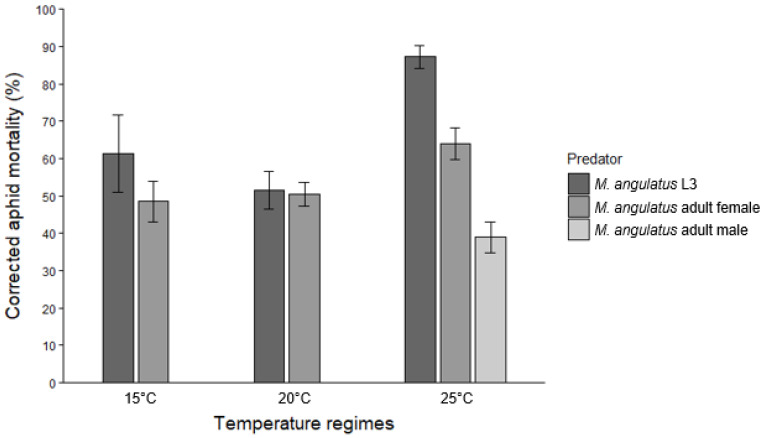 Figure 2
Peer Reviews
No public reviews on file for this paper yet. If you reviewed it on a platform where reviews are public (OpenReview, ICLR, NeurIPS, ICML), you can paste yours below so the community can read it here.
Videos
No videos yet. Explain this paper in a talk, walkthrough, or lecture? Add one.
Taxonomy
TopicsInsect-Plant Interactions and Control · Forest Insect Ecology and Management · Insect Pest Control Strategies