“Reverse” Dual Stimulation Has Comparable Efficacy, but Higher Efficiency, than Two Conventional Follicular Phase Stimulations in Poor Responders Undergoing In Vitro Fertilization
Andrea Roberto Carosso, Chiara Benedetto, Bernadette Evangelisti, Marco Carosso, Gianvito Contangelo, Stefano Canosa, Gianluca Gennarelli, Alberto Revelli

TL;DR
A new method of ovarian stimulation in IVF allows immediate embryo transfer and shortens the time to pregnancy for poor responders without reducing success rates.
Contribution
Reverse dual stimulation enables fresh embryo transfer and reduces time to pregnancy compared to conventional methods in poor responders.
Findings
Reverse dual stimulation (R-DS) achieved comparable oocyte retrieval and live birth rates to conventional methods.
R-DS significantly reduced the time to pregnancy by allowing immediate fresh embryo transfer.
Progesterone levels remained low and endometrial thickness was adequate for fresh embryo transfer in R-DS.
Abstract
Background/Objectives: Dual stimulation starting in the follicular phase allows retrieval of more oocytes than single follicular-phase controlled ovarian stimulation (COS). However, dual stimulation excludes fresh embryo transfer (ET), forcing us to postpone the first ET. If dual stimulation is performed in a reverse way (“reverse”-dual stimulation, R-DS), fresh ET can be performed, potentially reducing the time to pregnancy. The aim of the present study is to investigate reproductive outcomes of R-DS compared to two consecutive COS starting in the follicular phase (2FP-COS). Methods: A retrospective study was performed on 146 poor responders matching Bologna criteria, among which 45 underwent R-DS and 101 received 2FP-COS. In the R-DS group, the first COS began 5 days after ovulation and the second 5 days after oocyte retrieval. The primary outcome was the time to pregnancy. Results:…
Genes, proteins, chemicals, diseases, species, mutations and cell lines named across the full text — each resolved to its canonical identifier and authoritative record.
Click any figure to enlarge with its caption.
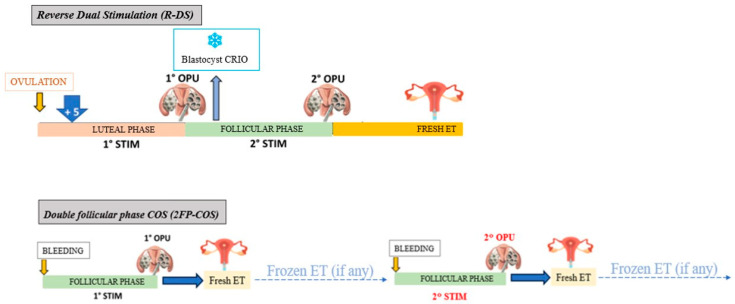 Figure 1
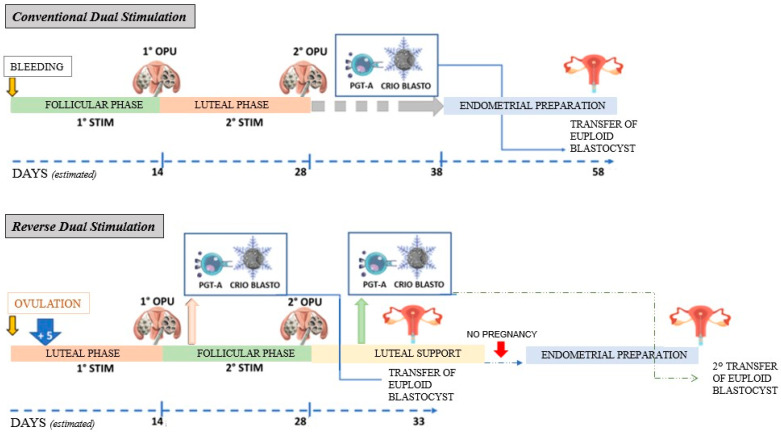 Figure 2
Peer Reviews
No public reviews on file for this paper yet. If you reviewed it on a platform where reviews are public (OpenReview, ICLR, NeurIPS, ICML), you can paste yours below so the community can read it here.
Videos
No videos yet. Explain this paper in a talk, walkthrough, or lecture? Add one.
Taxonomy
TopicsOvarian function and disorders · Reproductive Biology and Fertility · Reproductive Health and Technologies