Radial Extracorporeal Shock Wave Therapy Versus Multimodal Physical Therapy in Non-Traumatic (Degenerative) Rotator Cuff Tendinopathy with Partial Supraspinatus Tear: A Randomized Controlled Trial
Zheng Wang, Lan Tang, Ni Wang, Lihua Huang, Christoph Schmitz, Jun Zhou, Yingjie Zhao, Kang Chen, Yanhong Ma

TL;DR
A study found that radial extracorporeal shock wave therapy (rESWT) was more effective than physical therapy for treating shoulder tendon issues, providing faster pain relief and better recovery.
Contribution
This is the first randomized controlled trial comparing rESWT and multimodal physical therapy for non-traumatic rotator cuff tendinopathy with partial supraspinatus tear.
Findings
rESWT resulted in greater and faster improvement in shoulder function and pain reduction compared to physical therapy.
rESWT led to better patient satisfaction and improved range of motion in shoulder abduction, flexion, and external rotation.
Ultrasound imaging showed rESWT reduced tendon thickness and increased acromiohumeral distance, indicating tendon remodeling.
Abstract
Background/Objectives: Non-traumatic (degenerative) rotator cuff tendinopathy with partial supraspinatus tear (NT-RCTT) is a common source of shoulder pain and disability. Comparative evidence between radial extracorporeal shock wave therapy (rESWT) and multimodal physical therapy modalities (PTMs) remains scarce. Methods: In this single-center randomized controlled trial, 60 adults with MRI-confirmed NT-RCTT were assigned (1:1) to rESWT (one session weekly for six weeks; 2000 impulses per session, 2 bar air pressure, positive energy flux density 0.08 mJ/mm2; 8 impulses per second) or a multimodal PTM program (interferential current, shortwave diathermy and magnetothermal therapy; five sessions weekly for six weeks). All participants performed standardized home exercises. The primary outcome was the American Shoulder and Elbow Surgeons (ASES) total score; secondary outcomes included…
Genes, proteins, chemicals, diseases, species, mutations and cell lines named across the full text — each resolved to its canonical identifier and authoritative record.
Click any figure to enlarge with its caption.
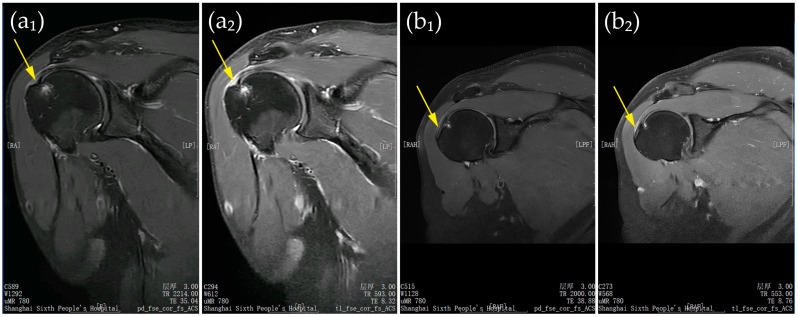 Figure 1
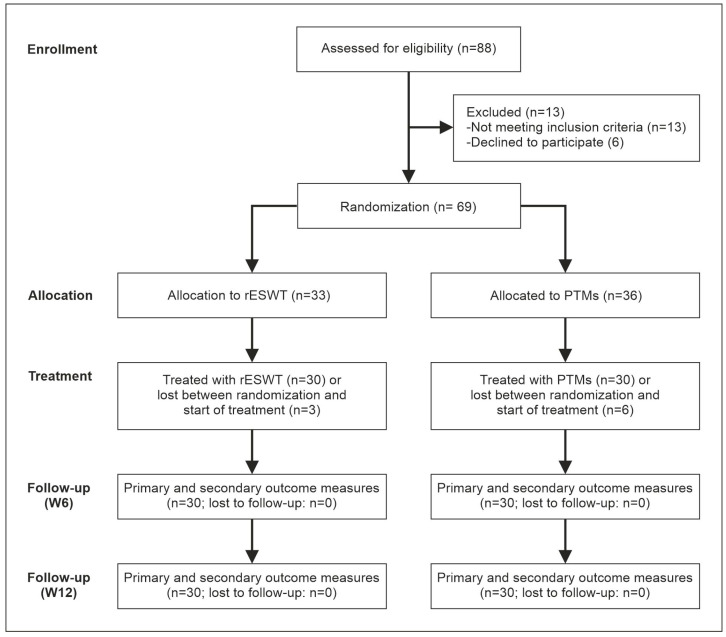 Figure 2
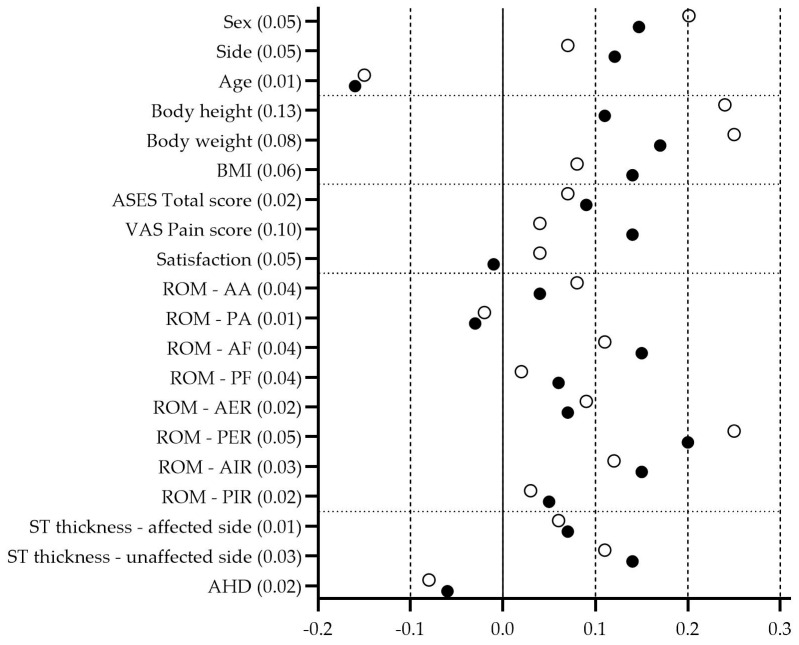 Figure 3
 Figure 4
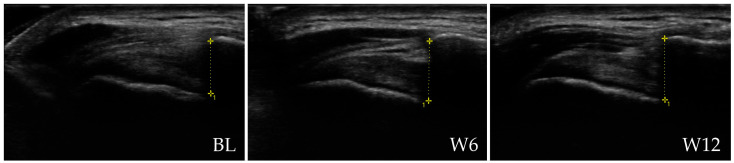 Figure 5
Peer Reviews
No public reviews on file for this paper yet. If you reviewed it on a platform where reviews are public (OpenReview, ICLR, NeurIPS, ICML), you can paste yours below so the community can read it here.
Videos
No videos yet. Explain this paper in a talk, walkthrough, or lecture? Add one.
Taxonomy
TopicsShoulder Injury and Treatment · Tendon Structure and Treatment · Myofascial pain diagnosis and treatment