Clinical Parameters Associated with Achieving Negative Fluid Balance in Critically Ill Patients: A Retrospective Cohort Study
Dekel Stavi, Amir Gal Oz, Nimrod Adi, Roy Rafael Dayan, Yoel Angel, Andrey Nevo, Nardeen Khoury, Itay Moshkovits, Yael Lichter, Ron Wald, Noam Goder

TL;DR
This study finds that blood pressure levels strongly influence how well critically ill patients respond to diuretics to reduce fluid overload.
Contribution
The study identifies mean arterial pressure (MAP) as the strongest predictor of diuretic response in critically ill patients.
Findings
MAP > 90 mmHg was associated with the greatest fluid removal (-899 mL/24h).
Vasopressor use, renal dysfunction, and higher SOFA scores reduced diuretic effectiveness.
Each 1 mmHg increase in MAP correlated with 23.3 mL greater fluid removal.
Abstract
Background/Objectives: Fluid overload in critically ill patients is linked to adverse outcomes. While resuscitation strategies are well established, guidance for the de-resuscitation phase remains limited. This study aimed to identify clinical factors associated with diuretic response and achieving negative fluid balance (FB) in critically ill patients. Methods: We conducted a single-center, retrospective cohort study of ICU patients who received intravenous furosemide between 2017 and 2023. A CHAID (Chi-square Automatic Interaction Detector) decision tree identified clinical variables associated with fluid removal after the first dose, and a mixed-effects model analyzed repeated measurements. Results: The cohort comprised 1764 patients over 6632 ICU days. Mean arterial pressure (MAP) was the strongest predictor of negative FB. MAP ≤ 75 mmHg yielded minimal negative FB (−33 ± 1054 mL/24…
Genes, proteins, chemicals, diseases, species, mutations and cell lines named across the full text — each resolved to its canonical identifier and authoritative record.
Click any figure to enlarge with its caption.
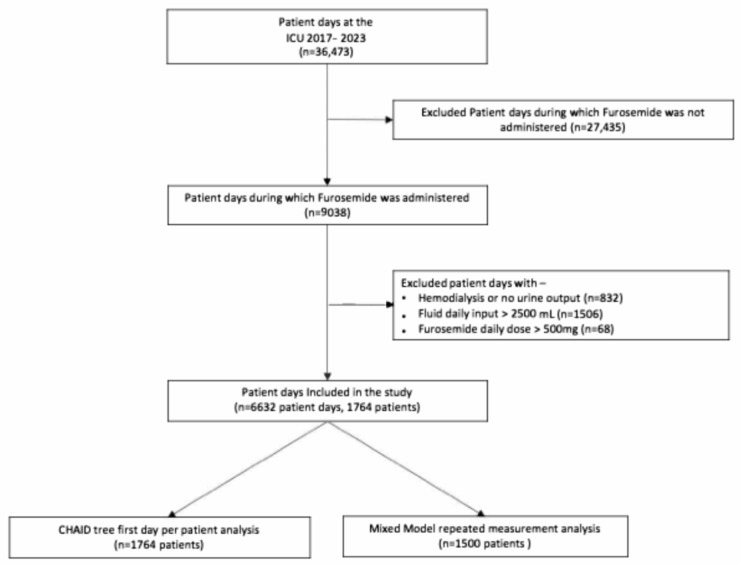 Figure 1
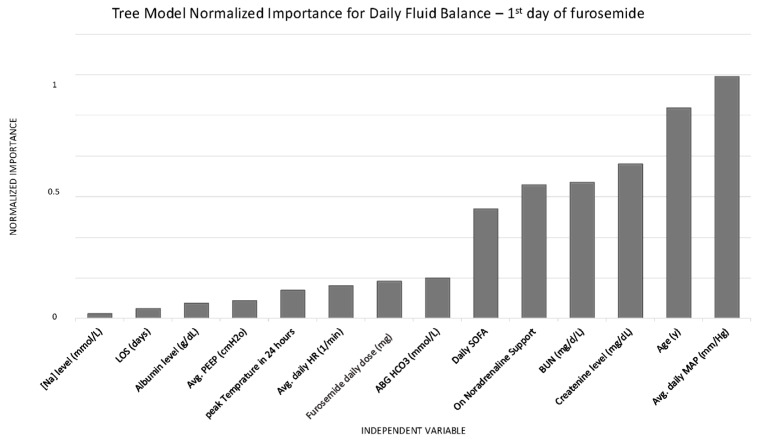 Figure 2
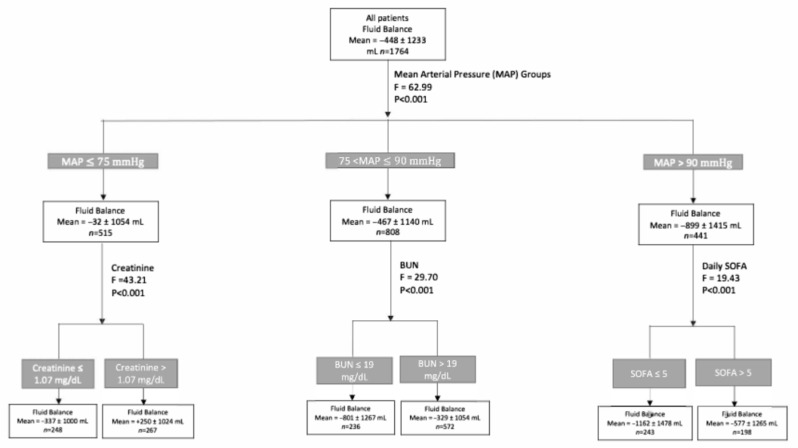 Figure 3
Peer Reviews
No public reviews on file for this paper yet. If you reviewed it on a platform where reviews are public (OpenReview, ICLR, NeurIPS, ICML), you can paste yours below so the community can read it here.
Videos
No videos yet. Explain this paper in a talk, walkthrough, or lecture? Add one.
Taxonomy
TopicsHemodynamic Monitoring and Therapy · Trauma, Hemostasis, Coagulopathy, Resuscitation · Acute Kidney Injury Research