Chemical Ecology of Host- and Mate-Finding in the Cypress Bark Beetle Phloeosinus aubei, with Notes on Congeneric Species
Gábor Bozsik, Armin Tröger, Stefan Schulz, Michael J. Domingue, Gábor Szőcs

TL;DR
This paper reviews the chemical signals used by the cypress bark beetle to find hosts and mates, aiming to develop traps for pest control.
Contribution
The paper provides a detailed overview of the chemical communication system of Phloeosinus aubei and its congeneric species.
Findings
Host selection by females relies on kairomones from host plants.
Aggregation pheromones attract conspecifics and are reinforced during mass colonization.
An inhibitory signal limits population density to prevent over-colonization.
Abstract
The Mediterranean cypress bark beetle (CBB), Phloeosinus aubei, is a serious xylophagous pest of scale-leaved conifers of the Cupressaceae family. Its increasing silvicultural importance and accelerated spread, favored by climate change and driven by international timber trade, has brought it into the focus of chemoecological research. The latest investigations on host plant volatiles and intraspecific signaling have paved the way for the development of attractant traps for monitoring and mass trapping. In this review, we provide insight into the complex chemical communication system of P. aubei. First, host selection by the females occurs using kairomones. Then aggregation pheromones attract more conspecifics, initially produced by the pioneering females and reinforced by both sexes as mass colonization ensues. Finally, an inhibitory signal is emitted to limit population density.…
Genes, proteins, chemicals, diseases, species, mutations and cell lines named across the full text — each resolved to its canonical identifier and authoritative record.
Click any figure to enlarge with its caption.
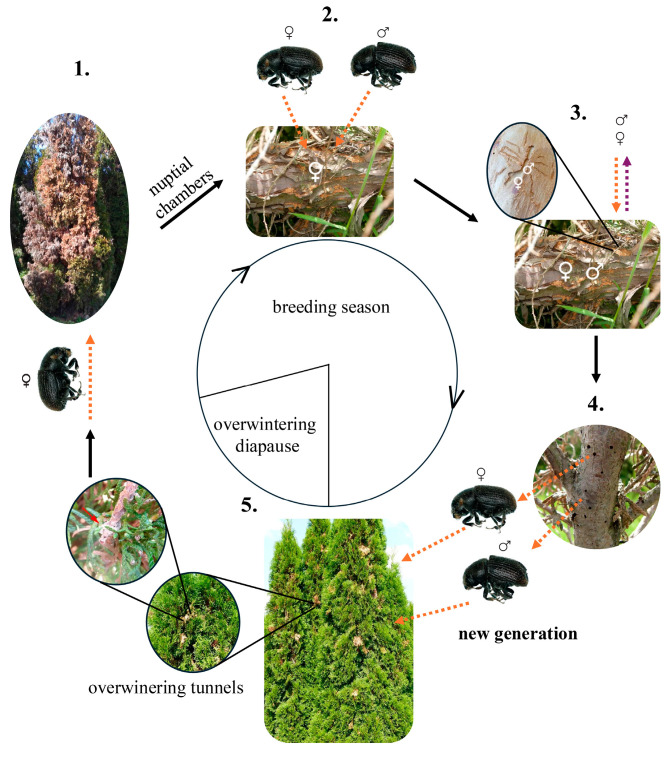 Figure 1
 Figure 2
 Figure 3
 Figure 4
Peer Reviews
No public reviews on file for this paper yet. If you reviewed it on a platform where reviews are public (OpenReview, ICLR, NeurIPS, ICML), you can paste yours below so the community can read it here.
Videos
No videos yet. Explain this paper in a talk, walkthrough, or lecture? Add one.
Taxonomy
TopicsForest Insect Ecology and Management · Forest Ecology and Biodiversity Studies · Coleoptera: Cerambycidae studies