Gastrointestinal Diagnostic Coding After Spinal Cord Injury: Health Behavior Correlates and Implications for Neurogenic Bowel Management in a Nationwide Claim-Based Cohort
Young-Hwan Lim, Jae-Hyeong Yoo, Jeong-Won Park, Jong-Moon Hwang, Dongwoo Kang, Jungkuk Lee, Hyun Wook Han, Kyung-Tae Kim, Myung-Gwan Kim, Tae-Du Jung

TL;DR
This study examines how gastrointestinal diagnostic codes are used after spinal cord injury in a large Korean population, finding that these codes reflect management needs rather than new diseases.
Contribution
The study provides population-level evidence on the use of GI diagnostic codes after SCI in administrative healthcare systems.
Findings
Irritable bowel syndrome and functional bowel disorders were the most frequently recorded GI codes after SCI.
Higher disability severity, female sex, older age, and rural residence were linked to increased odds of GI diagnostic coding.
Physical activity was inversely associated with GI diagnostic coding, suggesting a potential role in rehabilitation.
Abstract
Background: Neurogenic bowel dysfunction (NBD) is a major chronic sequela of spinal cord injury (SCI) with substantial implications for rehabilitation and long-term management. However, population-level evidence describing how gastrointestinal (GI) diagnostic codes are used following SCI, particularly within administrative healthcare systems, remains limited. Methods: We conducted a nationwide retrospective cohort study using administrative claims data from the Korean National Health Insurance Service (NHIS). A total of 584,266 adults with trauma-related SCI encounters between 2009 and 2019 were identified. GI diagnostic codes—paralytic ileus (K56), irritable bowel syndrome (K58), and functional bowel disorders (K59)—were evaluated as administrative proxies for bowel dysfunction. Demographic characteristics, disability status, regional factors, and health behaviors were analyzed using…
Genes, proteins, chemicals, diseases, species, mutations and cell lines named across the full text — each resolved to its canonical identifier and authoritative record.
Click any figure to enlarge with its caption.
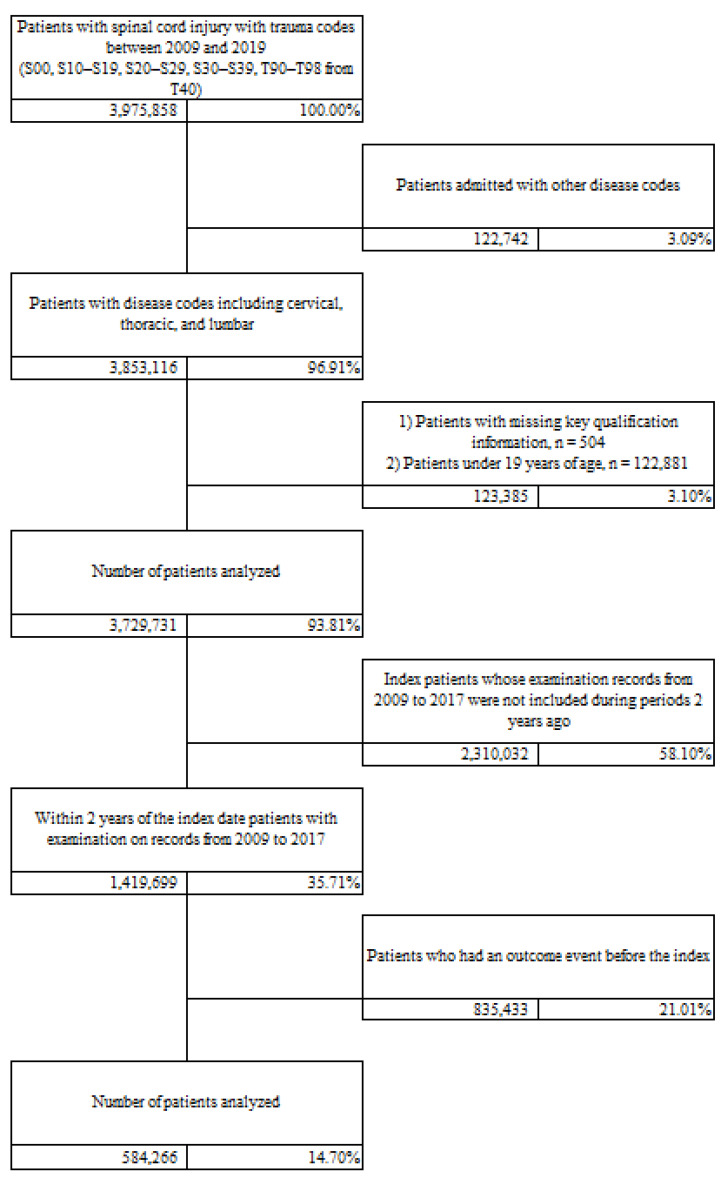 Figure 1
Peer Reviews
No public reviews on file for this paper yet. If you reviewed it on a platform where reviews are public (OpenReview, ICLR, NeurIPS, ICML), you can paste yours below so the community can read it here.
Videos
No videos yet. Explain this paper in a talk, walkthrough, or lecture? Add one.
Taxonomy
TopicsGastrointestinal motility and disorders · Enhanced Recovery After Surgery · Dysphagia Assessment and Management