The Effects of a Cerebellar Transcranial Direct-Current Stimulation-Based Preventive Exercise Program on Physical Function and Fall Reduction Efficacy in Community-Dwelling Older Adults
Deone Kang, JongEun Yim

TL;DR
Using cerebellar transcranial direct-current stimulation before exercise improved strength and balance in older adults, but not static balance or fear of falling.
Contribution
This study shows that combining c-tDCS with exercise enhances physical function in older adults more effectively than exercise alone.
Findings
c-tDCS combined with exercise significantly improved lower-extremity muscle strength and dynamic balance in older adults.
No significant changes were observed in static balance or fall efficacy after the 4-week intervention.
Longer intervention durations or multicomponent approaches may be needed to improve static balance and reduce fear of falling.
Abstract
What are the main findings? Administration of cerebellar transcranial direct-current stimulation (c-tDCS) prior to an Otago Exercise Program (OEP)-based fall prevention exercise program significantly improved lower-extremity muscle strength (Five Times Sit to Stand Test, FTSST) and dynamic balance (Time Up to Go, TUG) in older adults.No significant changes were observed in static balance (Balancia) or fall efficacy (Falls Efficacy Scale—Korean ver., FES-K) following the short-term, 4-week intervention. Administration of cerebellar transcranial direct-current stimulation (c-tDCS) prior to an Otago Exercise Program (OEP)-based fall prevention exercise program significantly improved lower-extremity muscle strength (Five Times Sit to Stand Test, FTSST) and dynamic balance (Time Up to Go, TUG) in older adults. No significant changes were observed in static balance (Balancia) or fall…
Genes, proteins, chemicals, diseases, species, mutations and cell lines named across the full text — each resolved to its canonical identifier and authoritative record.
Click any figure to enlarge with its caption.
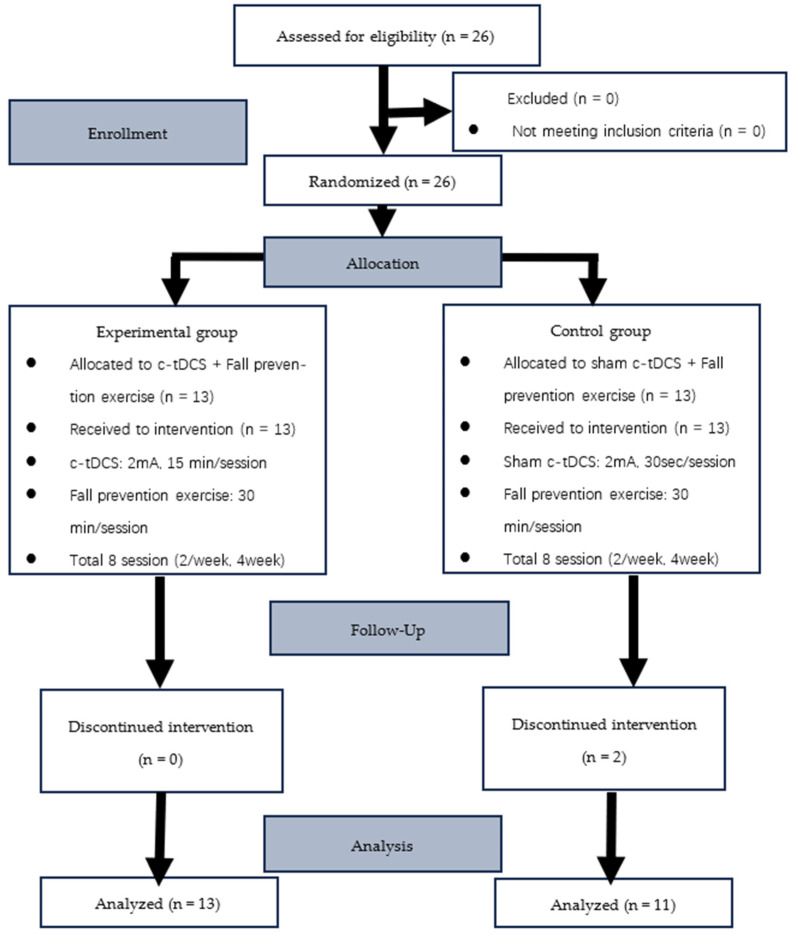 Figure 1
Peer Reviews
No public reviews on file for this paper yet. If you reviewed it on a platform where reviews are public (OpenReview, ICLR, NeurIPS, ICML), you can paste yours below so the community can read it here.
Videos
No videos yet. Explain this paper in a talk, walkthrough, or lecture? Add one.
Taxonomy
TopicsTranscranial Magnetic Stimulation Studies · Balance, Gait, and Falls Prevention · Vestibular and auditory disorders