Mapping Competence in Gastrointestinal Endoscopy Nursing Practice: An Item Response Theory Analysis of Perceived Skill Acquisition and Maintenance in Italy
Mattia Bozzetti, Gennaro Pascale, Ilaria Marcomini, Alessio Lo Cascio, Fabio Grilli, Caterina Sclapari, Grazia Multari, Nicoletta Orgiana, Mirko Gaggiotti, Giorgio Iori, Luciana Nicola Giordano, Stefano Mancin, Fabio Petrelli, Giovanni Cangelosi, Loris Riccardo Lopetuso

TL;DR
This study identifies how many times nurses in Italy need to perform specific endoscopic procedures to gain and maintain competence, highlighting the need for standardized training.
Contribution
The study introduces a validated, procedure-specific competence map for gastrointestinal endoscopy nursing in Italy using item response theory.
Findings
Complex or infrequently performed endoscopic techniques require higher repetition thresholds for competence acquisition.
More experienced nurses set higher internal standards for competence, indicating stricter self-assessment.
Competence maintenance generally requires fewer repetitions than acquisition, but varies by procedure.
Abstract
Advanced gastrointestinal endoscopy requires specific nursing competences to ensure procedural safety, efficiency, and patient-centered care. International frameworks define core skills and assessment methods, but Italy lacks a standardized, nationally recognized competency model, leading to variability in training and practice. What are the main findings? This study quantifies perceived procedural repetition thresholds for both competence acquisition and maintenance across 30 endoscopic procedures. It demonstrates that complex or infrequently performed techniques require higher perceived thresholds and that more experienced nurses set stricter internal standards. The findings provide a validated, procedure-specific competence map for Italian endoscopy nursing. This study quantifies perceived procedural repetition thresholds for both competence acquisition and maintenance across 30…
Genes, proteins, chemicals, diseases, species, mutations and cell lines named across the full text — each resolved to its canonical identifier and authoritative record.
Click any figure to enlarge with its caption.
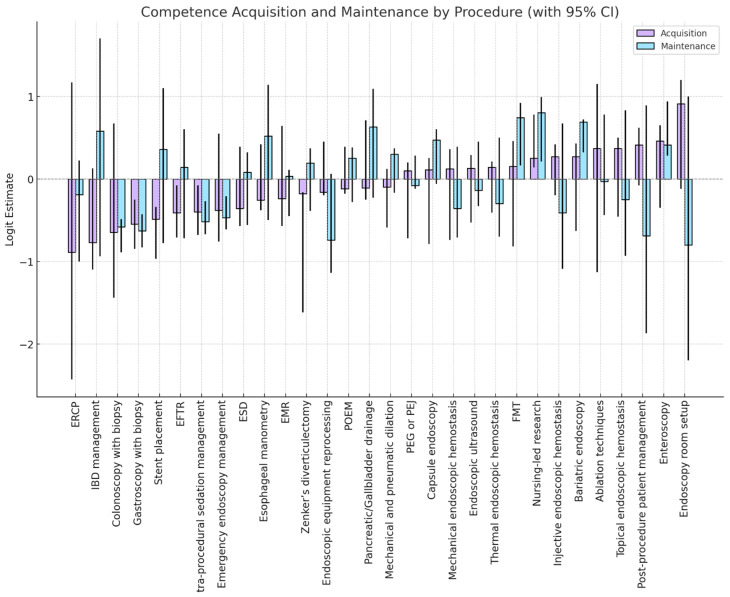 Figure 1
Peer Reviews
No public reviews on file for this paper yet. If you reviewed it on a platform where reviews are public (OpenReview, ICLR, NeurIPS, ICML), you can paste yours below so the community can read it here.
Videos
No videos yet. Explain this paper in a talk, walkthrough, or lecture? Add one.
Taxonomy
TopicsSurgical Simulation and Training · Colorectal Cancer Screening and Detection · Innovations in Medical Education