Validation of the Ambivalence and Uncertainty Scale
Julia-Katharina Matthias, Andreas M. Baranowski, Anna C. Culmann, Simone C. Tüttenberg, Yesim Erim, Eva Morawa, Petra Beschoner, Lucia Jerg-Bretzke, Christian Albus, Sabine Mogwitz, Franziska Geiser

TL;DR
This study validated a new scale to measure how healthcare professionals handle uncertainty and ambivalence, especially during stressful events like the pandemic.
Contribution
The Ambivalence and Uncertainty Scale (AUS) was validated as a unidimensional tool with strong psychometric properties for measuring uncertainty tolerance.
Findings
The AUS showed a unidimensional structure explaining 64.33% of variance.
The scale had strong internal consistency (Cronbach’s α = 0.86) and good convergent and divergent validity.
AUS scores correlated with anxiety, depression, and burnout, but not with unrelated constructs like fatigue.
Abstract
Background: This study aimed to validate the Ambivalence and Uncertainty Scale (AUS), developed to measure dispositional ambivalence, ambivalence intolerance, and decision-making difficulties, particularly among healthcare professionals during high-stress situations such as the COVID-19 pandemic. Method: Cross-sectional data from 1240 German healthcare professionals were analyzed. Exploratory factor analysis (EFA) was employed to evaluate the scale’s dimensionality, while internal consistency and construct validity, including convergent and divergent validity, were assessed using correlations with relevant psychological constructs. Results: The EFA revealed a unidimensional structure explaining 64.33% of variance, indicating a single underlying trait. The AUS demonstrated excellent internal consistency (Cronbach’s α = 0.86) and strong convergent validity, evidenced by significant…
Genes, proteins, chemicals, diseases, species, mutations and cell lines named across the full text — each resolved to its canonical identifier and authoritative record.
Click any figure to enlarge with its caption.
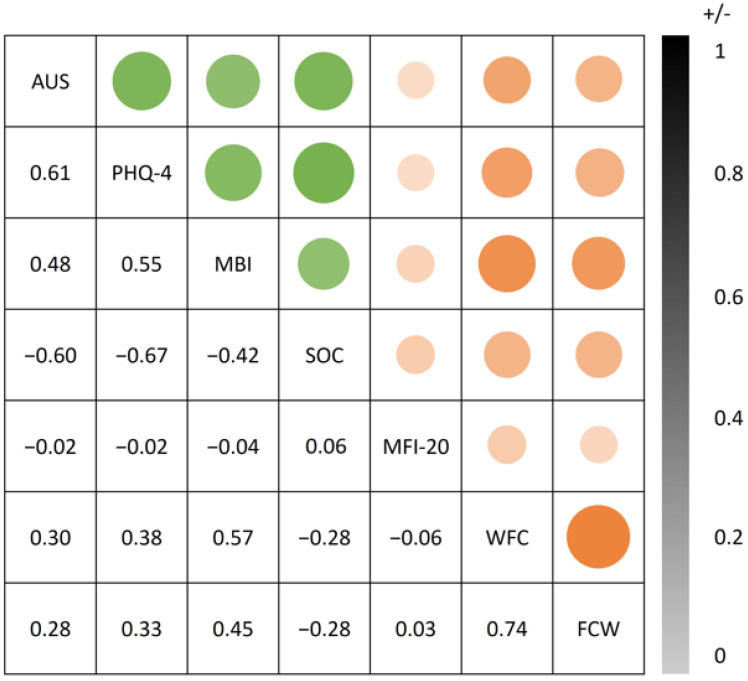 Figure 1
Peer Reviews
No public reviews on file for this paper yet. If you reviewed it on a platform where reviews are public (OpenReview, ICLR, NeurIPS, ICML), you can paste yours below so the community can read it here.
Videos
No videos yet. Explain this paper in a talk, walkthrough, or lecture? Add one.
Taxonomy
TopicsHealthcare professionals’ stress and burnout · Health, psychology, and well-being · COVID-19 and Mental Health