Pulmonary Embolism in Antiphospholipid Syndrome (APS)—Where Are We and Where Are We Going?
Mateusz Lucki, Bogna Grygiel-Górniak, Ewa Lucka, Maciej Lesiak, Aleksander Araszkiewicz

TL;DR
This review discusses the challenges and future directions in managing pulmonary embolism in antiphospholipid syndrome, a condition linked to blood clots and autoimmune factors.
Contribution
The paper provides a comprehensive overview of current knowledge and future therapeutic strategies for pulmonary embolism in APS.
Findings
Triple-positive aPLA profiles significantly increase the risk of recurrent pulmonary embolism and long-term complications like CTEPH.
Long-term vitamin K antagonists are the standard treatment, while direct oral anticoagulants are not recommended for high-risk APS patients.
Future strategies include better risk assessment using aPLA profiling and targeted therapies like complement inhibition.
Abstract
Pulmonary embolism (PE) is one of the most serious complications of antiphospholipid syndrome (APS), a systemic autoimmune disorder defined by thrombotic events and persistent antiphospholipid antibodies (aPLA). PE occurs in 11–20% of patients and may constitute the initial clinical manifestation. Young and middle-aged women are most frequently affected, and triple-positive aPLA profiles markedly increase the risk of recurrence and long-term morbidity, including chronic thromboembolic pulmonary hypertension (CTEPH). This review article summarizes current evidence on the epidemiology, pathophysiology, diagnostic approach, and management of PE in APS. Key mechanisms include anti-β2-glycoprotein I-mediated endothelial and platelet activation, complement engagement, and neutrophil extracellular trap formation, resulting in immunothrombosis. Diagnostic pathways follow standard PE algorithms;…
Genes, proteins, chemicals, diseases, species, mutations and cell lines named across the full text — each resolved to its canonical identifier and authoritative record.
Click any figure to enlarge with its caption.
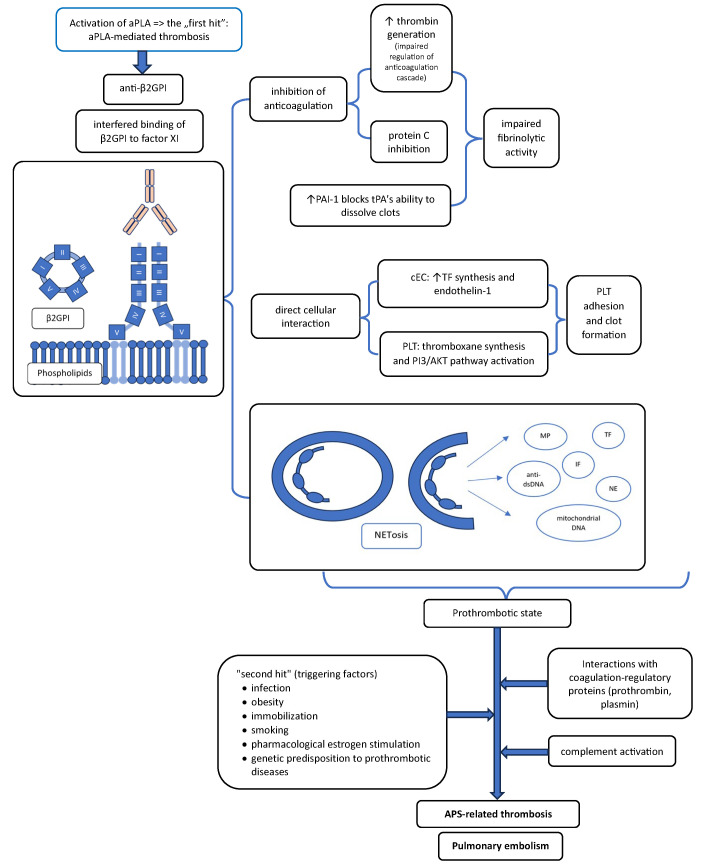 Figure 1
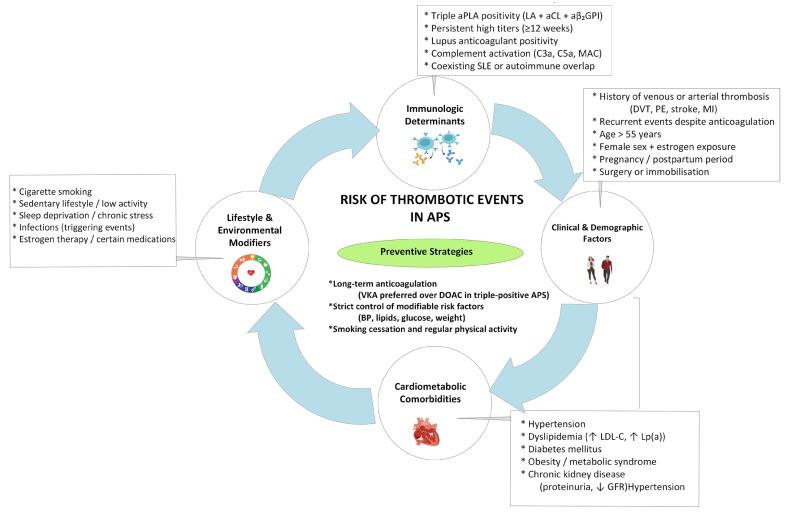 Figure 2
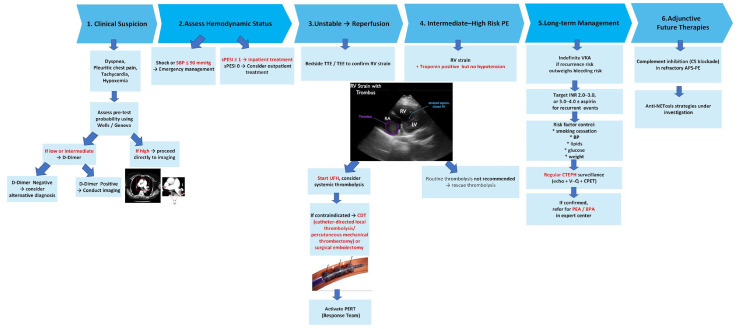 Figure 3
Peer Reviews
No public reviews on file for this paper yet. If you reviewed it on a platform where reviews are public (OpenReview, ICLR, NeurIPS, ICML), you can paste yours below so the community can read it here.
Videos
No videos yet. Explain this paper in a talk, walkthrough, or lecture? Add one.
Taxonomy
TopicsSystemic Lupus Erythematosus Research · Pulmonary Hypertension Research and Treatments · Heparin-Induced Thrombocytopenia and Thrombosis