Variability and Number of Circulating csd Alleles in a Honey Bee Breeding Population After Four Years of Single-Drone Insemination
Maria Grazia De Iorio, Barbara Lazzari, Maria Cristina Silvia Cozzi, Michele Polli, Giulietta Minozzi

TL;DR
A study shows that selective breeding in honey bees can maintain some genetic diversity at a key gene despite controlled mating.
Contribution
The study demonstrates partial maintenance of csd allelic diversity in honey bees under selective breeding with single-drone insemination.
Findings
Seven distinct csd alleles were identified, with five being previously described and two novel.
The most common allele was present in nine colonies with a frequency of 31%.
The population's expected heterozygosity was 0.79, indicating moderate genetic diversity.
Abstract
Background: Varroa destructor is the major threat to honey bee health, and selective breeding for resistance traits such as Varroa-sensitive hygiene represents a promising long-term strategy for controlling mite populations. However, breeding programs that rely on highly controlled mating schemes, including single-drone instrumental insemination, may reduce allelic diversity at the complementary sex determiner (csd) locus, potentially increasing the production of non-viable diploid males and compromising colony fitness. Methods: To evaluate whether csd diversity can be maintained under these conditions, we characterized the hypervariable region of csd in a selectively bred Apis mellifera population subjected to four years of selection. Using a validated de novo assembly pipeline, we reconstructed 43 amino-acid sequences from 33 diploid worker pupae sampled across 13 colonies. Results:…
Genes, proteins, chemicals, diseases, species, mutations and cell lines named across the full text — each resolved to its canonical identifier and authoritative record.
Click any figure to enlarge with its caption.
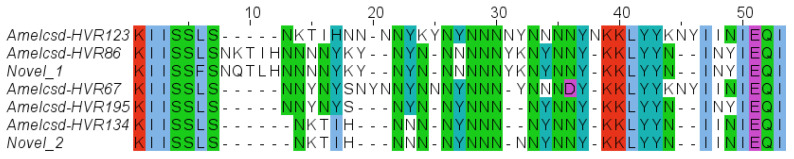 Figure 1
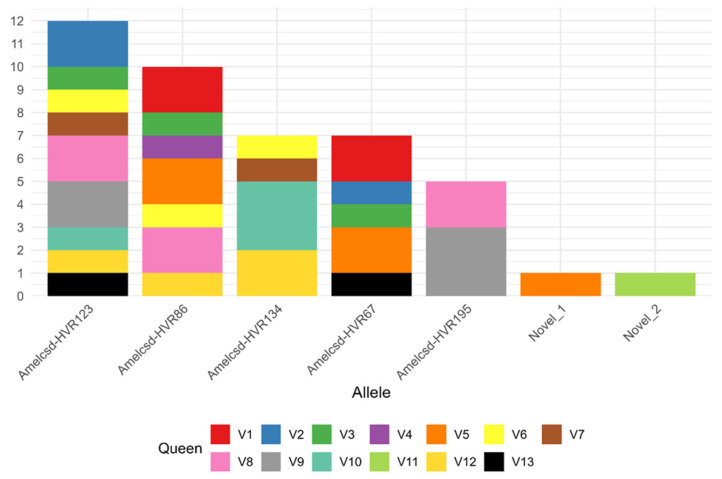 Figure 2
Peer Reviews
No public reviews on file for this paper yet. If you reviewed it on a platform where reviews are public (OpenReview, ICLR, NeurIPS, ICML), you can paste yours below so the community can read it here.
Videos
No videos yet. Explain this paper in a talk, walkthrough, or lecture? Add one.
Taxonomy
TopicsInsect and Arachnid Ecology and Behavior · Insect and Pesticide Research · Bee Products Chemical Analysis