Predicting Physical Appearance from Low Template: State of the Art and Future Perspectives
Francesco Sessa, Emina Dervišević, Massimiliano Esposito, Martina Francaviglia, Mario Chisari, Cristoforo Pomara, Monica Salerno

TL;DR
This paper reviews how machine learning improves predicting physical traits from low-quality DNA samples, highlighting current methods and future goals in forensic science.
Contribution
The paper evaluates recent ML advancements in forensic DNA phenotyping from low-template DNA, emphasizing predictive accuracy and ethical considerations.
Findings
ML models achieve AUC > 0.9 for eye color prediction from low-template DNA.
SNP recovery improves by up to 15% using genotype imputation techniques.
HIrisPlex-S and VISAGE panels show moderate accuracy for skin tone and emerging potential for age prediction.
Abstract
Background/Objectives: Forensic DNA phenotyping (FDP) enables the prediction of externally visible characteristics (EVCs) such as eye, hair, and skin color, ancestry, and age from biological traces. However, low template DNA (LT-DNA), often derived from degraded or trace samples, poses significant challenges due to allelic dropout, contamination, and incomplete profiles. This review evaluates recent advances in FDP from LT-DNA, focusing on the integration of machine learning (ML) models to improve predictive accuracy and operational readiness, while addressing ethical and population-related considerations. Methods: A comprehensive literature review was conducted on FDP and ML applications in forensic genomics. Key areas examined include SNP-based trait modeling, genotype imputation, epigenetic age estimation, and probabilistic inference. Comparative performance of ML algorithms (Random…
Click any figure to enlarge with its caption.
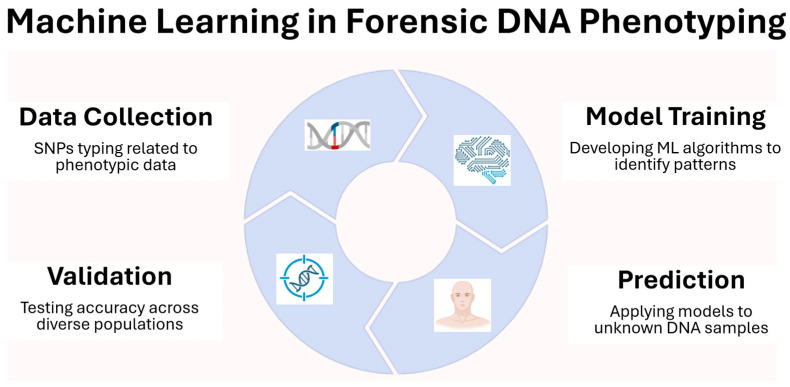 Figure 1
 Figure 2
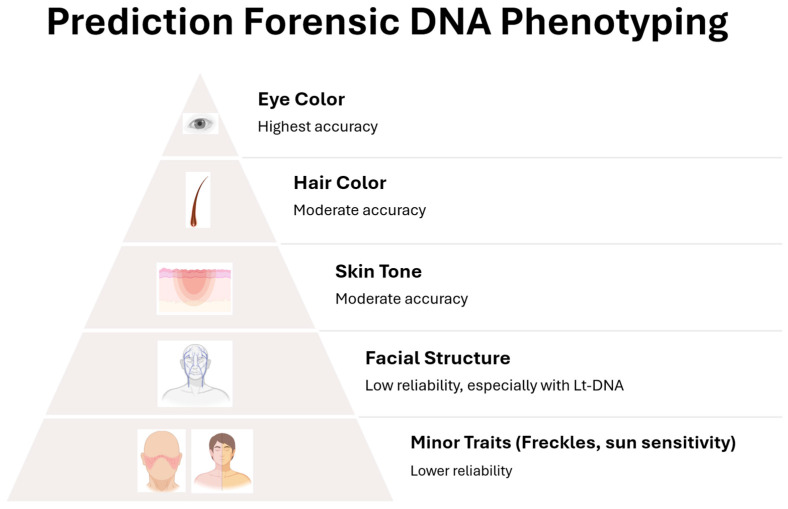 Figure 3
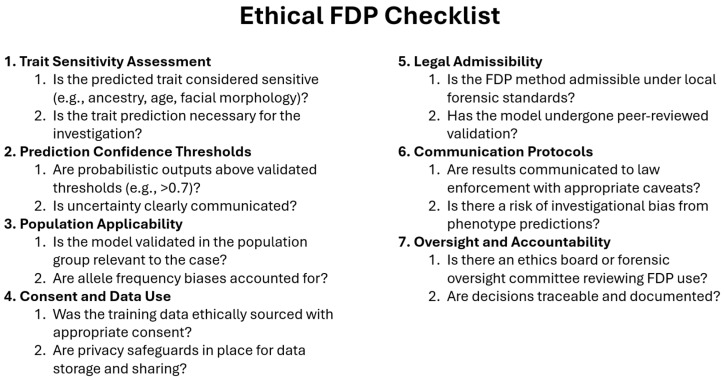 Figure 4
Peer Reviews
No public reviews on file for this paper yet. If you reviewed it on a platform where reviews are public (OpenReview, ICLR, NeurIPS, ICML), you can paste yours below so the community can read it here.
Videos
No videos yet. Explain this paper in a talk, walkthrough, or lecture? Add one.
Taxonomy
TopicsForensic and Genetic Research · melanin and skin pigmentation · Hair Growth and Disorders