Natural Essential Oils as Promising Antimicrobial Agents to Improve Food Safety: Mechanistic Insights Against Multidrug-Resistant Campylobacter jejuni and Campylobacter coli Isolated from Tunisia
Manel Gharbi, Chedia Aouadhi, Chadlia Hamdi, Safa Hamrouni, Abderrazak Maaroufi

TL;DR
This study explores how natural essential oils can combat drug-resistant Campylobacter bacteria in food, offering a safer alternative to antibiotics.
Contribution
The study identifies specific essential oils that effectively target multidrug-resistant Campylobacter species through membrane disruption.
Findings
Eucalyptus globulus, Thymus algeriensis, and Myrtus communis showed strong inhibition of Campylobacter jejuni.
Essential oils caused rapid bacterial reduction and membrane damage, as shown by time-kill and lysis experiments.
EO treatments reduced salt tolerance and induced cytoplasmic leakage, confirming membrane disruption.
Abstract
The increasing prevalence of multidrug-resistant (MDR) Campylobacter species poses a serious threat to food safety and public health, highlighting the urgent need for natural antimicrobial alternatives to conventional antibiotics. This study investigated the antibacterial potential and mechanism of action of seven essential oils (EOs), Cymbopogon citratus, Mentha pulegium, Artemisia absinthium, Myrtus communis, Thymus algeriensis, Thymus capitatus, and Eucalyptus globulus, against multidrug-resistant Campylobacter jejuni and Campylobacter coli. The antimicrobial activity was first assessed by the agar disk diffusion and broth microdilution methods to determine inhibition zones, minimum inhibitory concentrations (MICs), and minimum bactericidal concentrations (MBCs). The most active EOs were further evaluated through time–kill kinetics, cell lysis, salt tolerance, and membrane integrity…
Genes, proteins, chemicals, diseases, species, mutations and cell lines named across the full text — each resolved to its canonical identifier and authoritative record.
Click any figure to enlarge with its caption.
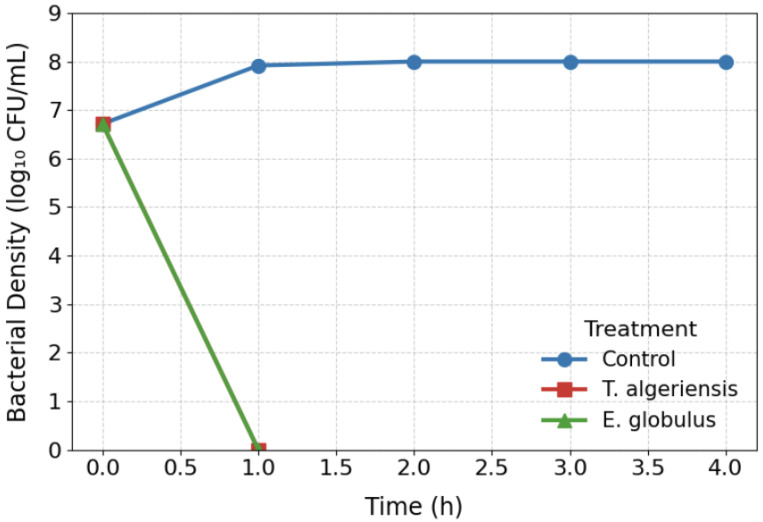 Figure 1
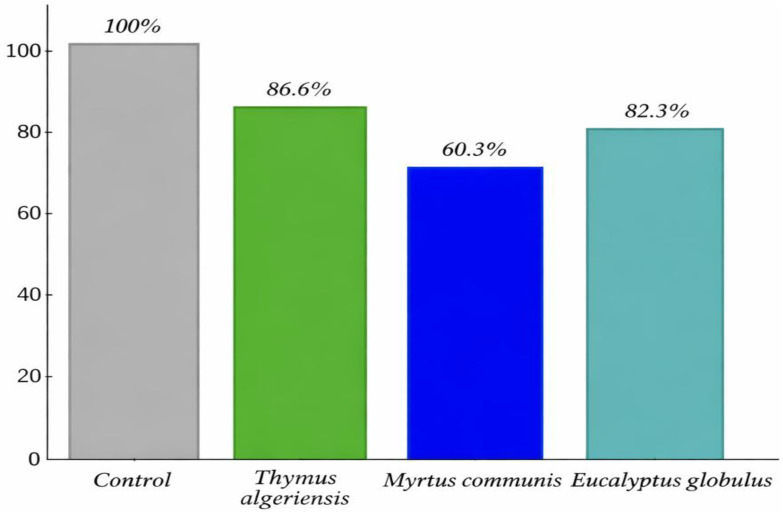 Figure 2
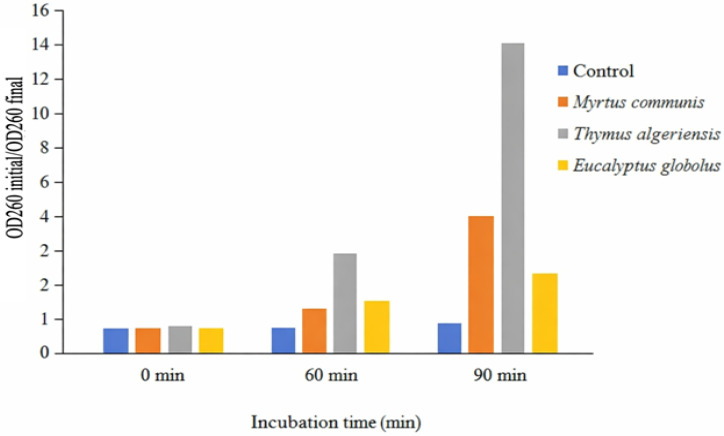 Figure 3
Peer Reviews
No public reviews on file for this paper yet. If you reviewed it on a platform where reviews are public (OpenReview, ICLR, NeurIPS, ICML), you can paste yours below so the community can read it here.
Videos
No videos yet. Explain this paper in a talk, walkthrough, or lecture? Add one.
Taxonomy
TopicsEssential Oils and Antimicrobial Activity · Salmonella and Campylobacter epidemiology · Nigella sativa pharmacological applications