IFRA: A Machine Learning-Based Instrumented Fall Risk Assessment Scale Derived from an Instrumented Timed Up and Go Test in Stroke Patients
Simone Macciò, Alessandro Carfì, Alessio Capitanelli, Peppino Tropea, Massimo Corbo, Fulvio Mastrogiovanni, Michela Picardi

TL;DR
This study introduces IFRA, a machine learning-based tool that improves fall risk assessment in stroke patients by analyzing movement data from an instrumented test.
Contribution
IFRA is a novel machine learning-derived fall risk scale that outperforms traditional clinical tools in identifying high-risk stroke patients.
Findings
Vertical and medio-lateral acceleration and angular velocity were key predictors of fall risk.
IFRA assigned more than half of actual fallers to the high-risk category, outperforming traditional scales.
IFRA showed statistically significant association with fall status (p = 0.004).
Abstract
Background/Objectives: Falls represent a major health concern for stroke survivors, necessitating effective risk assessment tools. This study proposes the Instrumented Fall Risk Assessment (IFRA) scale, a novel screening tool derived from Instrumented Timed Up and Go (ITUG) test data, designed to capture mobility measures often missed by traditional scales. Methods: We employed a two-step machine learning approach to develop the IFRA scale: first, identifying predictive mobility features from ITUG data and, second, creating a stratification strategy to classify patients into low-, medium-, or high-fall-risk categories. This study included 142 participants, who were divided into training (including synthetic cases), validation, and testing sets (comprising 22 non-fallers and 10 fallers). IFRA’s performance was compared against traditional clinical scales (e.g., standard TUG and…
Genes, proteins, chemicals, diseases, species, mutations and cell lines named across the full text — each resolved to its canonical identifier and authoritative record.
Click any figure to enlarge with its caption.
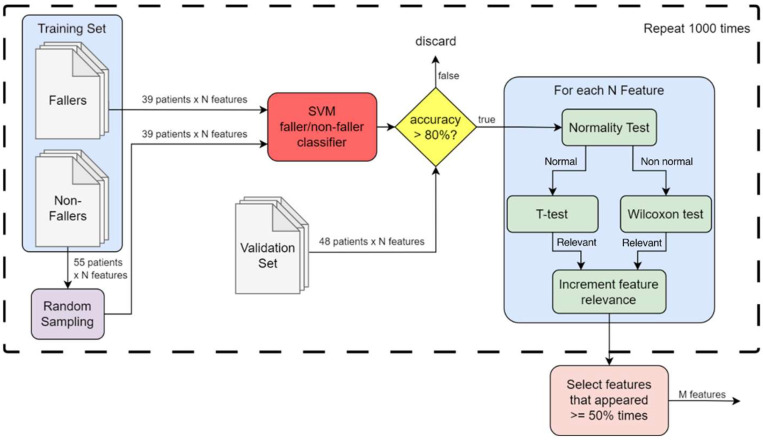 Figure 1
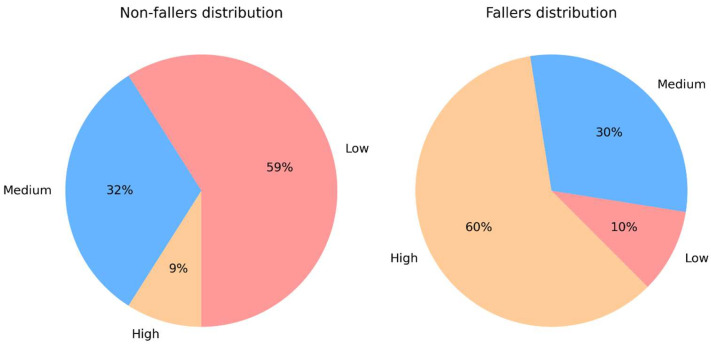 Figure 2
Peer Reviews
No public reviews on file for this paper yet. If you reviewed it on a platform where reviews are public (OpenReview, ICLR, NeurIPS, ICML), you can paste yours below so the community can read it here.
Videos
No videos yet. Explain this paper in a talk, walkthrough, or lecture? Add one.
Taxonomy
TopicsStroke Rehabilitation and Recovery