Prenatal Exome Sequencing: When Does Diagnostic Yield Meet Clinical Utility?
Alessia Carrer, Francesco Maria Crupano, Berardo Rinaldi, Giulietta Scuvera, Claudia Cesaretti, Valeria Nicotra, Silvana Gangi, Lorenzo Colombo, Gabriella Araimo, Matilde Tagliabue, Daniela Marchetti, Laura Pezzoli, Maria Garzo, Veronica Accurti, Grazia Volpe, Simona Boito

TL;DR
This study explores when prenatal exome sequencing can reliably predict a fetus's condition based on ultrasound findings and genetic data.
Contribution
The study evaluates the clinical utility of prenatal exome sequencing by determining when ultrasound findings can support genetic variant pathogenicity.
Findings
Prenatal exome sequencing achieved a molecular diagnosis in 43% of cases.
Blinded reanalysis showed a prenatal diagnosis was achievable in 95% of diagnosed cases.
Syndromic presentations were confirmed in most newborns and terminated pregnancies.
Abstract
Background/Objectives: Prenatal Exome Sequencing (pES) has revolutionized prenatal diagnosis in fetuses with congenital anomalies. Although its performance is very promising, previous pES studies have mainly focused on diagnostic yield, often without considering the actual impact on ongoing pregnancies. In this study, we aim to (1) assess whether a prenatal molecular diagnosis can reliably predict the clinical features of the unborn child and (2) determine the gestational age (gw) at which ultrasound (US) findings are sufficient to support the pathogenicity of genetic variants detected by pES. Methods: We retrospectively selected 47 cases complicated by US anomalies that underwent Exome Sequencing (ES) and for which complete clinical assessment was available. A blinded reanalysis of ES data was performed, considering only prenatal features. Results: In our cohort, standard ES led to a…
Genes, proteins, chemicals, diseases, species, mutations and cell lines named across the full text — each resolved to its canonical identifier and authoritative record.
Click any figure to enlarge with its caption.
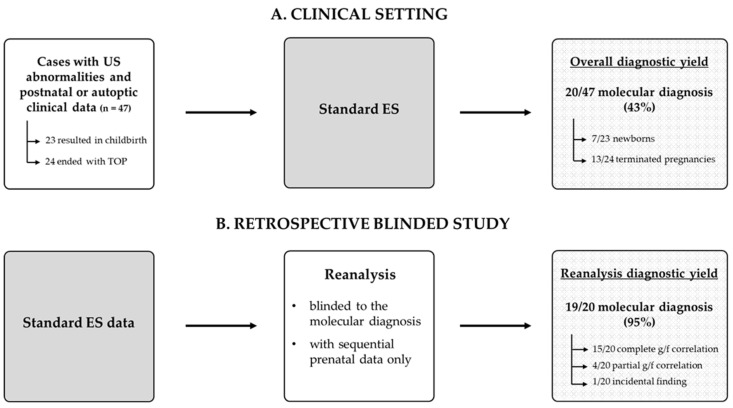 Figure 1
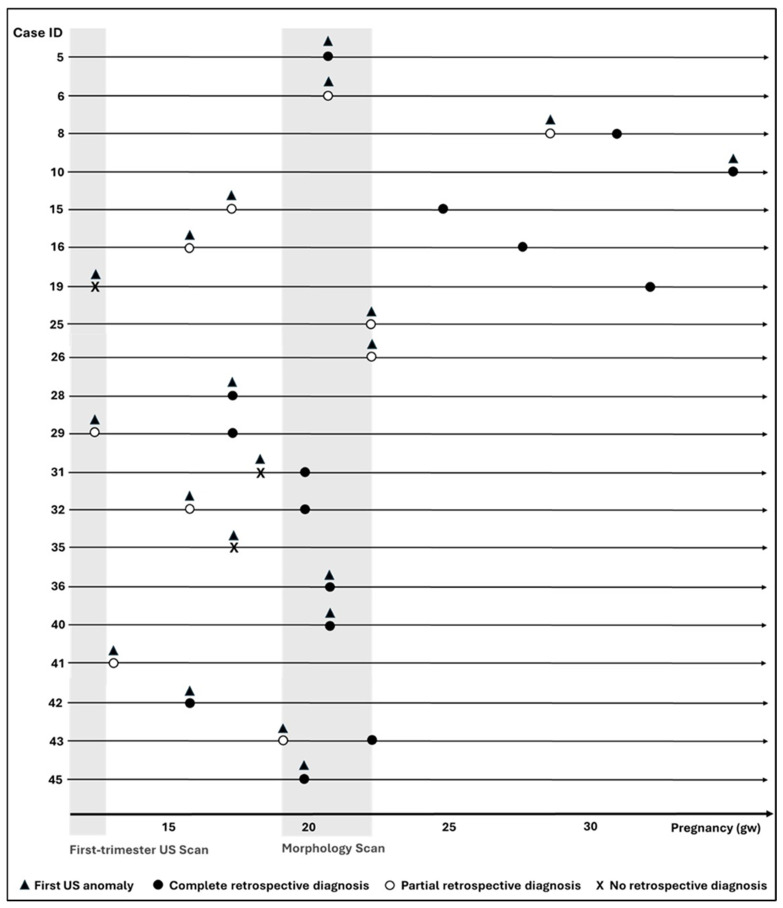 Figure 2
Peer Reviews
No public reviews on file for this paper yet. If you reviewed it on a platform where reviews are public (OpenReview, ICLR, NeurIPS, ICML), you can paste yours below so the community can read it here.
Videos
No videos yet. Explain this paper in a talk, walkthrough, or lecture? Add one.
Taxonomy
TopicsPrenatal Screening and Diagnostics · Genomics and Rare Diseases · Neurogenetic and Muscular Disorders Research