Quantitative Assessment of Soluble Carbohydrates in Two Panels of Pulses (Phaseolus vulgaris and Pisum sativum) Using Ultrasound-Assisted Extraction (UAE) and HPLC
Roberto Rodríguez Madrera, Ana Campa Negrillo, Juan José Ferreira Fernández

TL;DR
This study develops a fast and accurate method to measure soluble carbohydrates in beans and peas, revealing differences in sugar content that could help in breeding better varieties.
Contribution
A novel ultrasound-assisted extraction and HPLC method for quantifying soluble carbohydrates in pulses, showing its application in variety classification and breeding.
Findings
The method is fast (1 min extraction), accurate (97.5%), and reproducible (RDS: 6.9%).
Peas had higher total sugar content compared to beans, with notable differences in predominant sugars.
Local varieties with favorable sugar profiles were identified as valuable for breeding programs.
Abstract
Pulses (edible dry seeds from legumes) are among the most important crops worldwide. These legumes contain a diverse range of carbohydrates, some of which, such as RFOs (raffinose family oligosaccharides), are considered antinutritional factors due to their negative impact on digestion. An analytical method based on high-power ultrasound-assisted extraction and HPLC analysis was developed and validated for the quantitative determination of soluble carbohydrates (verbascose, stachyose, raffinose, sucrose, galactinol, glucose, galactose, fructose, and myo-inositol) in common beans (Phaseolus vulgaris) and peas (Pisum sativum). The proposed method is fast (extraction time: 1 min), reproducible (RDS: 6.9%), accurate (97.5%), and environmentally sustainable. The method was applied to local collections of P. vulgaris (n = 12) and P. sativum (n = 34), revealing similar qualitative profiles but…
Genes, proteins, chemicals, diseases, species, mutations and cell lines named across the full text — each resolved to its canonical identifier and authoritative record.
Click any figure to enlarge with its caption.
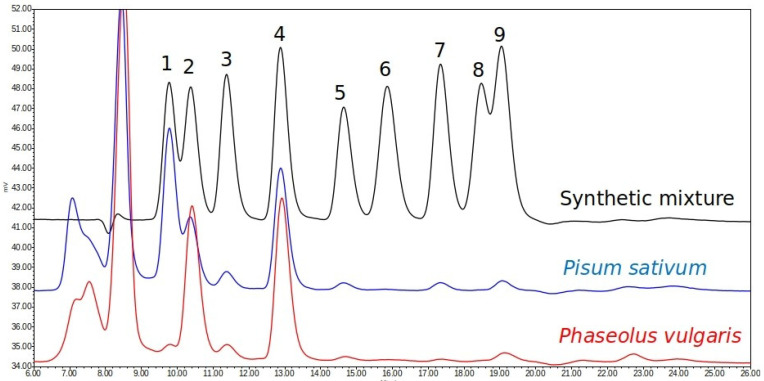 Figure 1
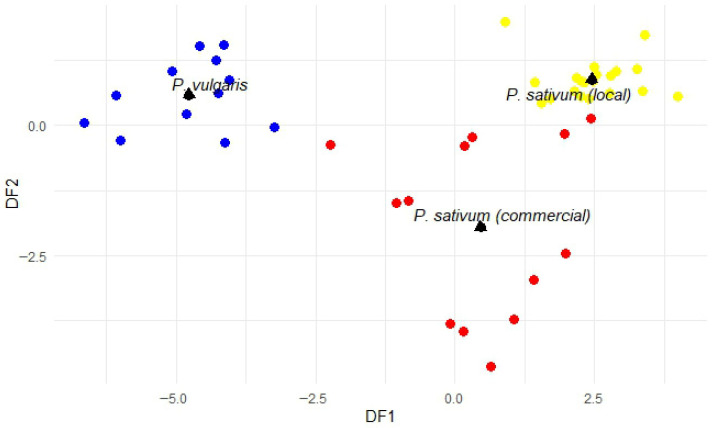 Figure 2
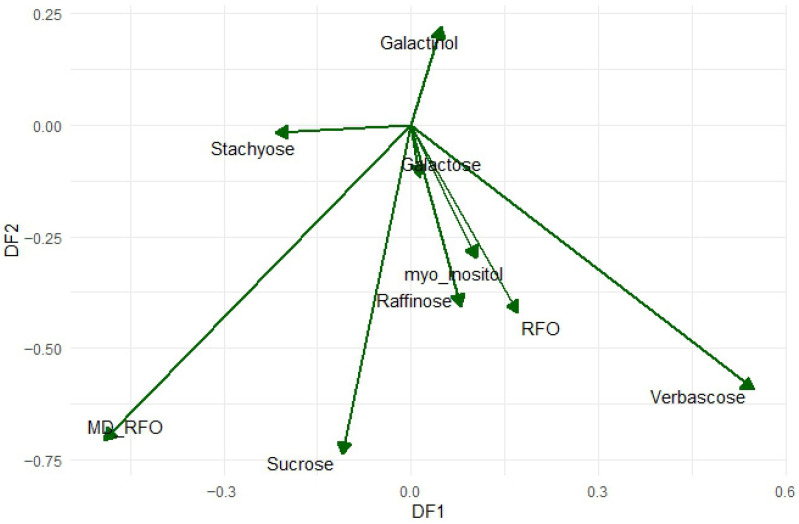 Figure 3
Peer Reviews
No public reviews on file for this paper yet. If you reviewed it on a platform where reviews are public (OpenReview, ICLR, NeurIPS, ICML), you can paste yours below so the community can read it here.
Videos
No videos yet. Explain this paper in a talk, walkthrough, or lecture? Add one.
Taxonomy
TopicsFood composition and properties · Proteins in Food Systems · Biochemical Analysis and Sensing Techniques