Biomolecular Condensates in Disease: Decoding the Material State and Engineering Precision Modulators
Biwei Han, Boxian Li, Xingyue Wang, Liang Wang

TL;DR
This paper explores how disruptions in biomolecular condensates contribute to disease and proposes new strategies to precisely modulate these structures for therapeutic purposes.
Contribution
The paper introduces a novel approach to targeting condensate dysfunction by reverse-engineering biophysical codes and developing programmable molecular tools.
Findings
Dysregulation of biomolecular condensates is linked to a wide range of diseases termed 'Condensatopathies'.
Current drug approaches are insufficient for addressing condensate-related disorders due to their complex nature.
Synthetic peptides and state-specific degraders offer promising tools for modulating pathological condensates.
Abstract
The recognition of liquid–liquid phase separation (LLPS) as a widespread organizing principle has revolutionized our view of cellular biochemistry. By forming biomolecular condensates, cells spatially orchestrate reactions without membranes. However, the dysregulation of this precise physical organization is emerging as a driver of diverse pathologies, collectively termed “Condensatopathies.” Unlike traditional proteinopathies defined by static aggregates, these disorders span a dynamic spectrum of material state dysfunctions, from the failure to assemble essential compartments to the formation of aberrant, toxic phases. While research has largely focused on neurodegeneration and cancer, the impact of condensate dysfunction likely extends across broad physiological landscapes. A central unresolved challenge lies in deciphering the “molecular grammar” that governs the transition from…
Genes, proteins, chemicals, diseases, species, mutations and cell lines named across the full text — each resolved to its canonical identifier and authoritative record.
Click any figure to enlarge with its caption.
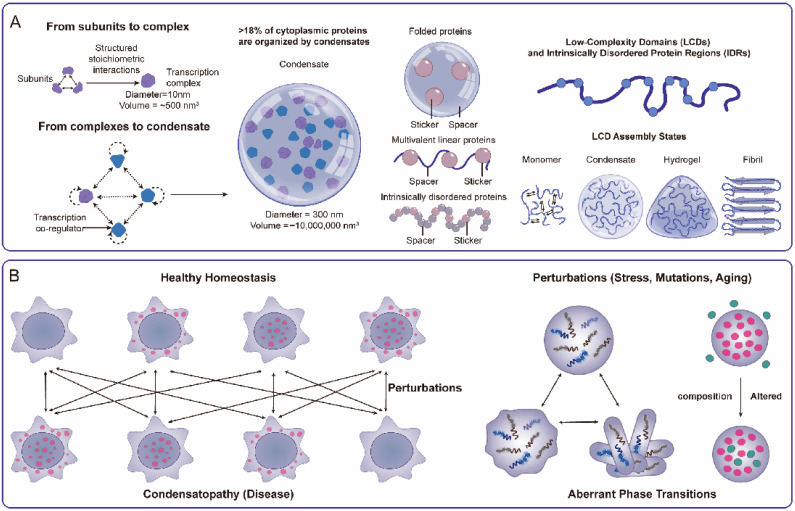 Figure 1
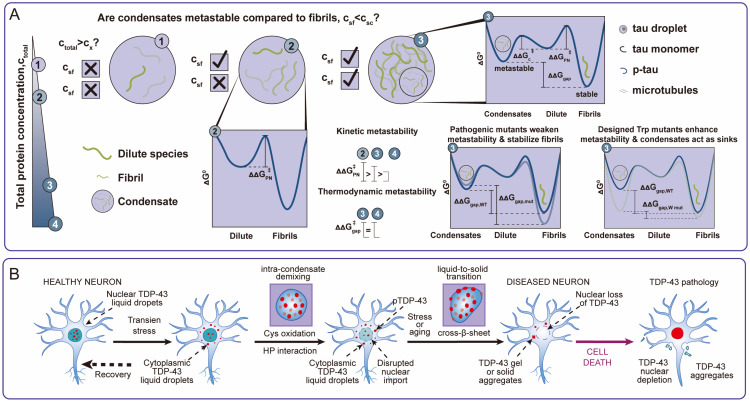 Figure 2
Peer Reviews
No public reviews on file for this paper yet. If you reviewed it on a platform where reviews are public (OpenReview, ICLR, NeurIPS, ICML), you can paste yours below so the community can read it here.
Videos
No videos yet. Explain this paper in a talk, walkthrough, or lecture? Add one.
Taxonomy
TopicsRNA Research and Splicing · Block Copolymer Self-Assembly · Nuclear Structure and Function