The Protonic Brain: Nanoscale pH Dynamics, Proton Wires, and Acid–Base Information Coding in Neural Tissue
Valentin Titus Grigorean, Catalina-Ioana Tataru, Cosmin Pantu, Felix-Mircea Brehar, Octavian Munteanu, George Pariza

TL;DR
This paper explores how protons in neurons form organized structures that influence energy dynamics and signaling, suggesting a new framework for neural computation.
Contribution
It introduces the concept of proton-based information coding and energy domains in neurons, revealing a novel computational substrate.
Findings
Protons in neurons form organized geometric configurations rather than diffusing randomly.
Proton micro-domains in mitochondria influence metabolic load and redox state through oscillating signals.
Proton gradients in organelles affect neurotransmitter release and cytoskeletal mechanics.
Abstract
Emerging research indicates that neuronal activity is maintained by an architectural system of protons in a multi-scale fashion. Proton architecture is formed when organelles (such as mitochondria, endoplasmic reticulum, lysosomes, synaptic vesicles, etc.) are coupled together to produce dynamic energy domains. Techniques have been developed to visualize protons in neurons; recent advances include near-atomic structural imaging of organelle interfaces using cryo-tomography and nanoscale resolution imaging of organelle interfaces and proton tracking using ultra-fast spectroscopy. Results of these studies indicate that protons in neurons do not diffuse randomly throughout the neuron but instead exist in organized geometric configurations. The cristae of mitochondrial cells create oscillating proton micro-domains that are influenced by the curvature of the cristae, hydrogen bonding between…
Genes, proteins, chemicals, diseases, species, mutations and cell lines named across the full text — each resolved to its canonical identifier and authoritative record.
Click any figure to enlarge with its caption.
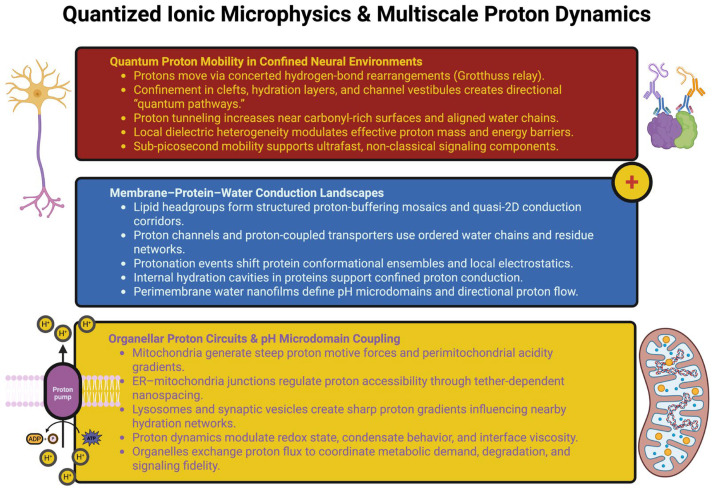 Figure 1
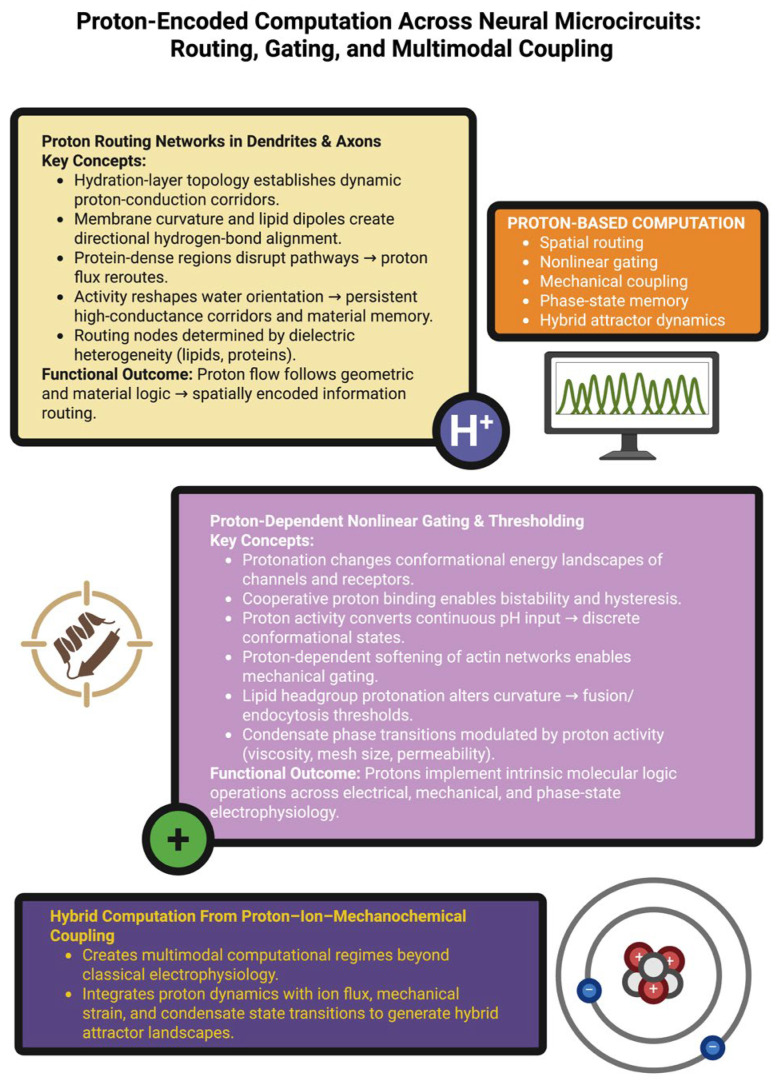 Figure 2
Peer Reviews
No public reviews on file for this paper yet. If you reviewed it on a platform where reviews are public (OpenReview, ICLR, NeurIPS, ICML), you can paste yours below so the community can read it here.
Videos
No videos yet. Explain this paper in a talk, walkthrough, or lecture? Add one.
Taxonomy
TopicsMitochondrial Function and Pathology · ATP Synthase and ATPases Research · Photoreceptor and optogenetics research