Evaluating the Accuracy, Usefulness, and Safety of ChatGPT for Caregivers Seeking Information on Congenital Muscular Torticollis
Siyun Kim, Seoyon Yang, Jaewon Kim, Sunyoung Joo, Hoo Young Lee, Hye Jung Park, Jongwook Jeon, You Gyoung Yi

TL;DR
This study evaluates how accurate and safe ChatGPT is for providing information to caregivers about congenital muscular torticollis, finding it generally reliable but with notable gaps.
Contribution
The study introduces a systematic evaluation of ChatGPT for caregiver-centered health information on CMT using clinical expert ratings and reproducibility metrics.
Findings
ChatGPT showed moderate lexical consistency and high semantic stability in responses.
Expert ratings revealed moderate to good performance, but some responses lacked clinical detail or safety cautions.
Human oversight is recommended before using LLM outputs in caregiver education.
Abstract
Background/Objectives: Caregivers of infants with congenital muscular torticollis (CMT) frequently seek information online, although the accuracy, clarity, and safety of web-based content remain variable. As large language models (LLMs) are increasingly used as health information tools, their reliability for caregiver education requires systematic evaluation. This study aimed to assess the reproducibility and quality of ChatGPT-5.1 responses to caregiver-centered questions regarding CMT. Methods: A set of 17 questions was developed through a Delphi process involving clinicians and caregivers to ensure relevance and comprehensiveness. ChatGPT generated responses in two independent sessions. Reproducibility was assessed using TF–IDF cosine similarity and embedding-based semantic similarity. Ten clinical experts evaluated each response for accuracy, readability, safety, and overall quality…
Genes, proteins, chemicals, diseases, species, mutations and cell lines named across the full text — each resolved to its canonical identifier and authoritative record.
Click any figure to enlarge with its caption.
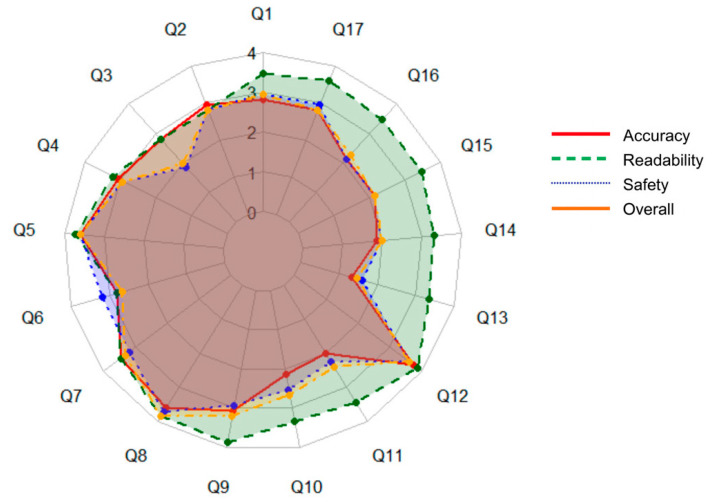 Figure 1
Peer Reviews
No public reviews on file for this paper yet. If you reviewed it on a platform where reviews are public (OpenReview, ICLR, NeurIPS, ICML), you can paste yours below so the community can read it here.
Videos
No videos yet. Explain this paper in a talk, walkthrough, or lecture? Add one.
Taxonomy
TopicsCraniofacial Disorders and Treatments · Genomics and Rare Diseases · Health Literacy and Information Accessibility