A Prevention-Focused Geospatial Epidemiology Framework for Identifying Multilevel Vulnerability Across Diverse Settings
Cindy Ogolla Jean-Baptiste

TL;DR
This paper introduces a geospatial framework to identify and address public health vulnerabilities by combining data on environment, structure, and behavior for targeted prevention.
Contribution
A novel geospatial architecture that translates multilevel data into localized risk signatures for precision prevention strategies.
Findings
Geospatial epidemiology reveals spatially patterned vulnerabilities influenced by ecological, structural, and built-environment factors.
Integrating spatial analytics improves early risk identification and enables equitable, context-aware public health interventions.
Abstract
What are the main findings? Geospatial epidemiology uncovers spatially patterned vulnerabilities driven by ecological, structural, and built-environment determinants.The proposed architecture translates multilevel data into localized risk signatures for precision prevention strategies. Geospatial epidemiology uncovers spatially patterned vulnerabilities driven by ecological, structural, and built-environment determinants. The proposed architecture translates multilevel data into localized risk signatures for precision prevention strategies. What are the implications of the main findings? Spatial intelligence enables earlier identification of risk, context-aware clinical screening, and targeted community-level interventions.Integrating geospatial analytics across systems helps overcome systemic data fragmentation, advancing equitable, context-responsive public health action. Spatial…
Genes, proteins, chemicals, diseases, species, mutations and cell lines named across the full text — each resolved to its canonical identifier and authoritative record.
Click any figure to enlarge with its caption.
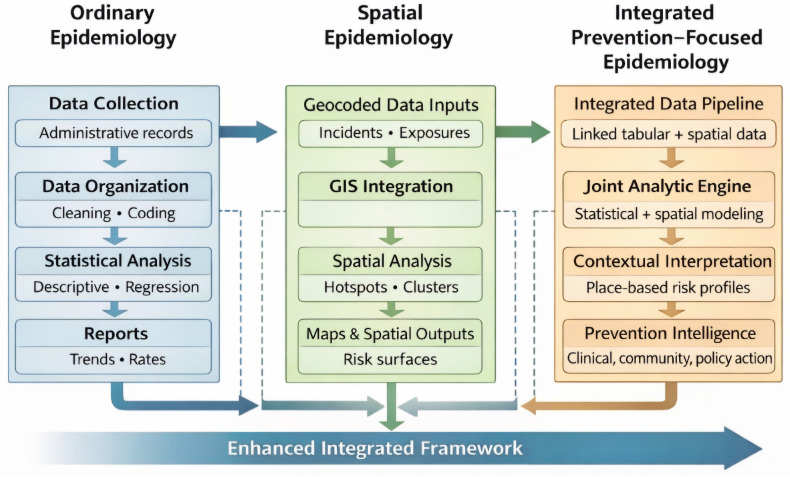 Figure 1
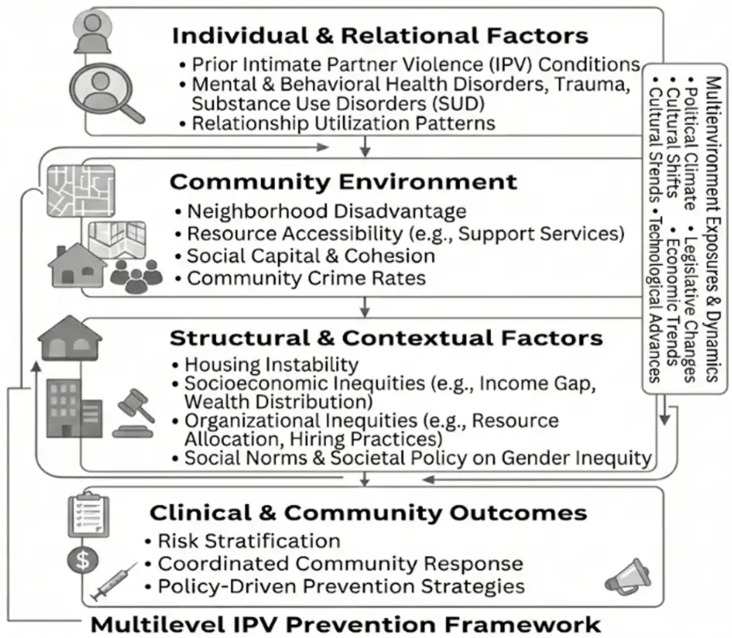 Figure 2
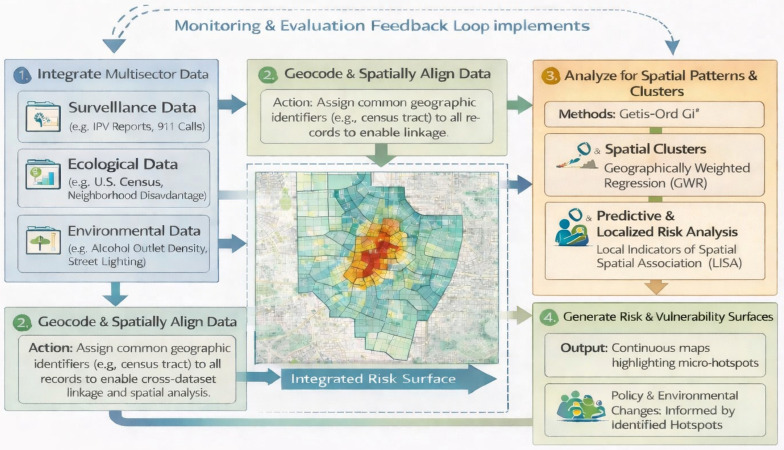 Figure 3
Peer Reviews
No public reviews on file for this paper yet. If you reviewed it on a platform where reviews are public (OpenReview, ICLR, NeurIPS, ICML), you can paste yours below so the community can read it here.
Videos
No videos yet. Explain this paper in a talk, walkthrough, or lecture? Add one.
Taxonomy
TopicsData-Driven Disease Surveillance · Gun Ownership and Violence Research · Injury Epidemiology and Prevention