AI-Resolved Protein Energy Landscapes, Electrodynamics, and Fluidic Microcircuits as a Unified Framework for Predicting Neurodegeneration
Cosmin Pantu, Alexandru Breazu, Stefan Oprea, Matei Serban, Razvan-Adrian Covache-Busuioc, Octavian Munteanu, Nicolaie Dobrin, Daniel Costea, Lucian Eva

TL;DR
This paper proposes a unified framework using AI and multi-physics models to predict and understand neurodegeneration by analyzing protein energy, electrodynamics, and fluid dynamics.
Contribution
The novel contribution is integrating protein energetics, electrodynamic drift, and fluid dynamics with AI to model early signs of neurodegeneration.
Findings
Small changes in protein conformations or membrane properties can destabilize neural systems before visible pathologies occur.
AI models can predict instability by detecting early deformation in multi-physics coherence.
Loss of ergodicity and attractor basin fragmentation may indicate vulnerability to neurodegeneration.
Abstract
Research shows that neurodegenerative processes do not develop from a single “broken” biochemistry process; rather, they develop when a complex multi-physics environment gradually loses its ability to stabilize the neuron via a collective action between the protein, ion, field and fluid dynamics of the neuron. The use of new technologies such as quantum-informed molecular simulation (QIMS), dielectric nanoscale mapping, fluid dynamics of the cell, and imaging of perivascular flow are allowing researchers to understand how the collective interactions among proteins, membranes and their electrical properties, along with fluid dynamics within the cell, form a highly interconnected dynamic system. These systems require fine control over the energetic, mechanical and electrical interactions that maintain their coherence. When there is even a small change in the protein conformations, the…
Genes, proteins, chemicals, diseases, species, mutations and cell lines named across the full text — each resolved to its canonical identifier and authoritative record.
Click any figure to enlarge with its caption.
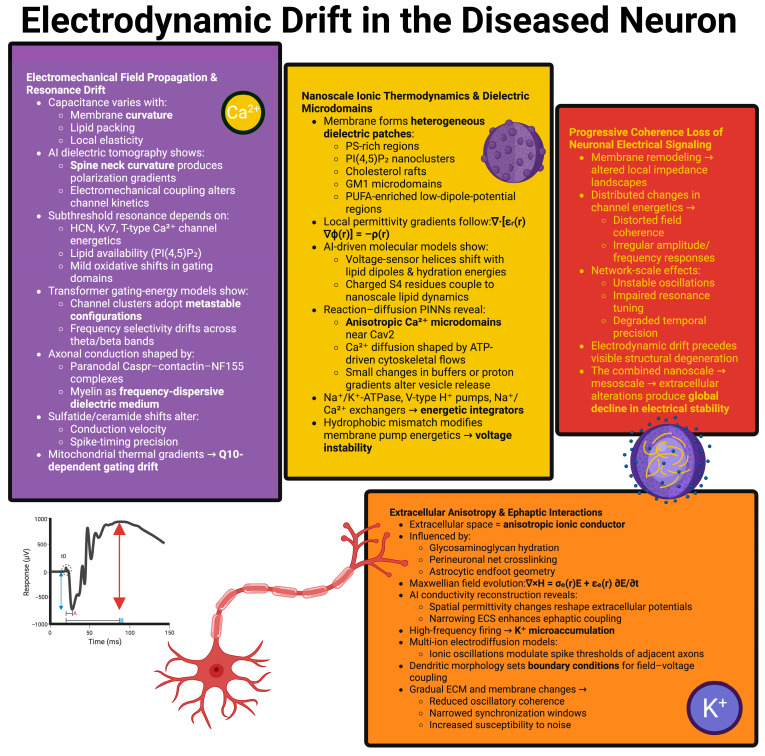 Figure 1
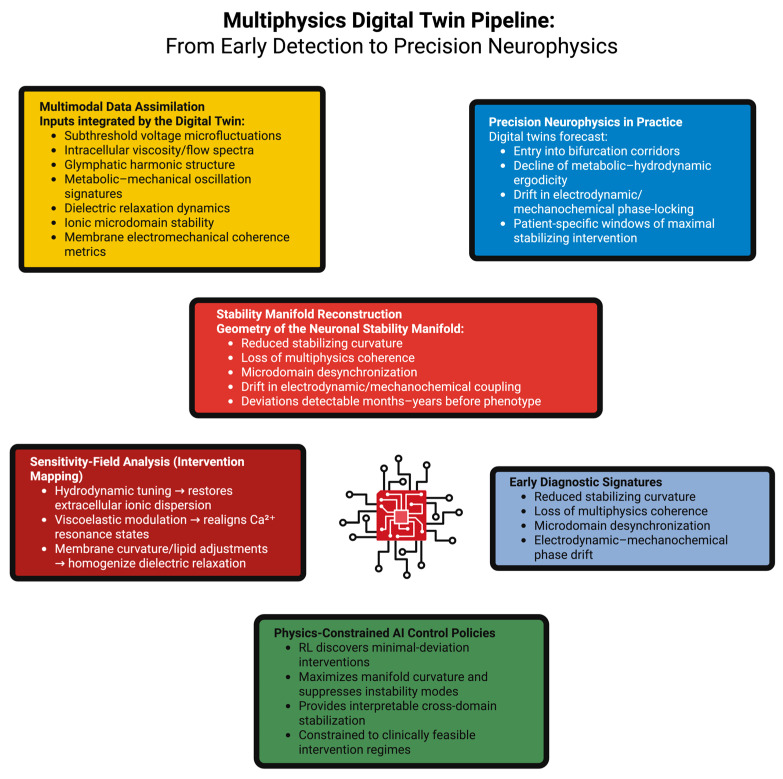 Figure 2
Peer Reviews
No public reviews on file for this paper yet. If you reviewed it on a platform where reviews are public (OpenReview, ICLR, NeurIPS, ICML), you can paste yours below so the community can read it here.
Videos
No videos yet. Explain this paper in a talk, walkthrough, or lecture? Add one.
Taxonomy
TopicsLipid Membrane Structure and Behavior · Ion channel regulation and function · Microfluidic and Bio-sensing Technologies