LLM-Assisted Scoping Review of Artificial Intelligence in Brazilian Public Health: Lessons from Transfer and Federated Learning for Resource-Constrained Settings
Fabiano Tonaco Borges, Gabriela do Manco Machado, Maíra Araújo de Santana, Karla Amorim Sancho, Giovanny Vinícius Araújo de França, Wellington Pinheiro dos Santos, Carlos Eduardo Gomes Siqueira

TL;DR
This study explores how AI, specifically Transfer Learning and Federated Learning, can help improve public health in Brazil by addressing data scarcity and privacy issues in resource-limited settings.
Contribution
The paper introduces a scoping review of AI applications in Brazil, emphasizing Transfer Learning and Federated Learning as novel solutions for public health challenges in the Global South.
Findings
Transfer Learning and Federated Learning are scalable and feasible for collaborative model training under privacy constraints.
These AI techniques remain underutilized in mainstream Brazilian healthcare despite their low resource requirements and data sovereignty benefits.
The study highlights the potential of resource-aware AI to promote equitable innovation in health systems of the Global South.
Abstract
Public health relevance—How does this work relate to a public health issue? Maps how artificial intelligence is currently applied within the Brazilian Unified Health System (SUS), identifying structural gaps between diagnostic innovation and health system integration.Examines Transfer Learning and Federated Learning as practical responses to public health challenges such as data scarcity, privacy protection, and infrastructure limitations in the Global South. Maps how artificial intelligence is currently applied within the Brazilian Unified Health System (SUS), identifying structural gaps between diagnostic innovation and health system integration. Examines Transfer Learning and Federated Learning as practical responses to public health challenges such as data scarcity, privacy protection, and infrastructure limitations in the Global South. Public health significance—Why is this work…
Genes, proteins, chemicals, diseases, species, mutations and cell lines named across the full text — each resolved to its canonical identifier and authoritative record.
Click any figure to enlarge with its caption.
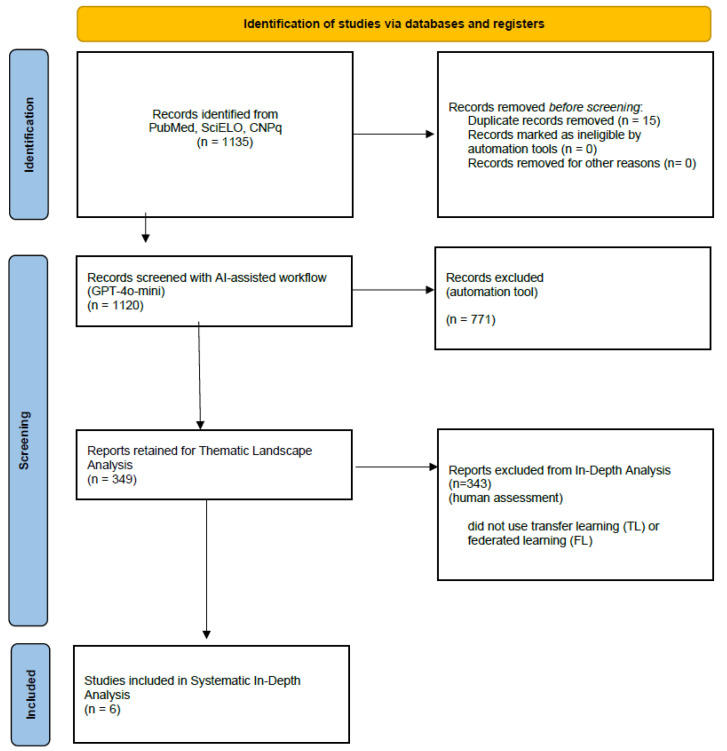 Figure 1
Peer Reviews
No public reviews on file for this paper yet. If you reviewed it on a platform where reviews are public (OpenReview, ICLR, NeurIPS, ICML), you can paste yours below so the community can read it here.
Videos
No videos yet. Explain this paper in a talk, walkthrough, or lecture? Add one.
Taxonomy
TopicsArtificial Intelligence in Healthcare and Education · Global Health and Surgery · COVID-19 Digital Contact Tracing