Measurement and Analysis of Vibronic Coupling in Two Dysprosium(III) Complexes of Opposite Magnetic Anisotropy
Yasmin L. Whyatt, Jack Emerson‐King, George F. S. Whitehead, David P. Mills, Stuart K. Langley, Mykhaylo Ozerov, Nicholas F. Chilton

TL;DR
This paper studies how molecular vibrations affect magnetic properties in dysprosium complexes using advanced spectroscopy techniques.
Contribution
The study provides direct experimental evidence of vibronic coupling effects in dysprosium complexes with opposite magnetic anisotropy.
Findings
A prominent spectral feature at 340 cm−1 was observed, corresponding to electronic excitation.
The vibronic coupling effect is shown to depend on the direction of the external magnetic field.
FIRMS is validated as a powerful tool for studying magnetic anisotropy and vibronic coupling.
Abstract
The loss of magnetic memory in single‐molecule magnets (SMMs) is caused by the coupling of molecular vibrations to spin states, which plays a significant role in magnetic relaxation processes. Gaining direct evidence of vibronic coupling using experimental techniques is critical to understanding and controlling this phenomenon. Most studies focus on assessing the spin‐phonon coupling in SMMs to help control this relaxation; herein we gain insight by comparing the SMM [Dy(OPCy3)2(H2O)5][CF3SO3]3.2(OPCy3) to the non‐SMM [Dy{N(SiMe3)2}3] through collection of far‐infrared magnetospectroscopy (FIRMS) spectra and validation with ab initio calculations. Single‐crystal measurements display a prominent feature in the spectra at 340 cm−1, corresponding to an electronic excitation which varies depending on the direction of external magnetic field applied. These findings demonstrate the…
Genes, proteins, chemicals, diseases, species, mutations and cell lines named across the full text — each resolved to its canonical identifier and authoritative record.
Click any figure to enlarge with its caption.
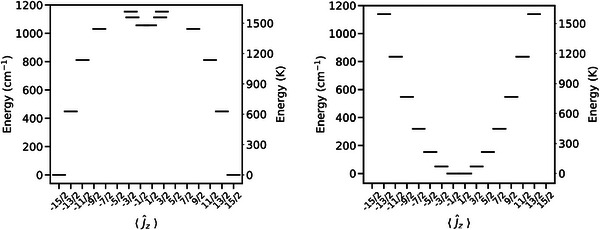 Figure 1
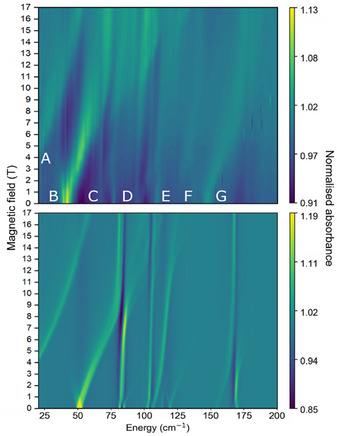 Figure 2
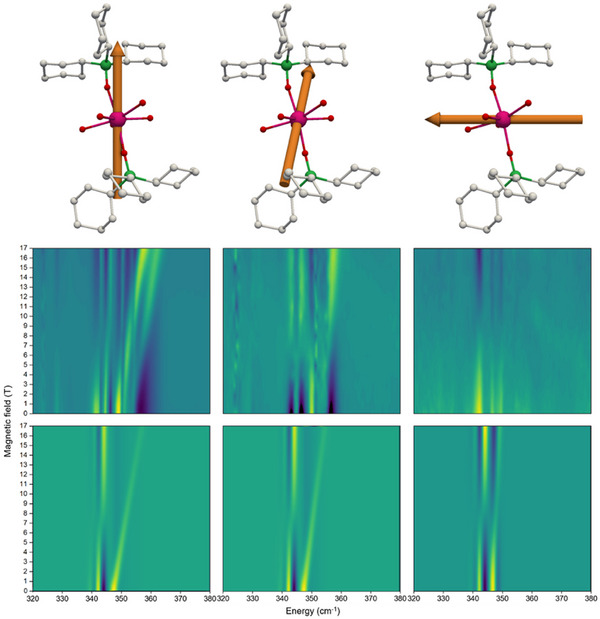 Figure 3
 Figure 4
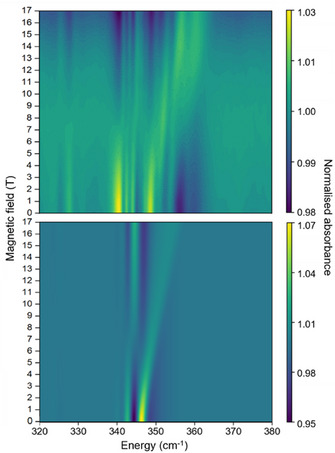 Figure 5
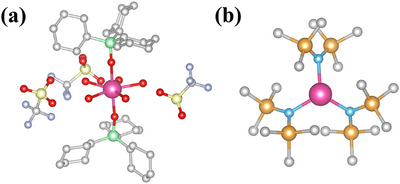 Figure 6
Peer Reviews
No public reviews on file for this paper yet. If you reviewed it on a platform where reviews are public (OpenReview, ICLR, NeurIPS, ICML), you can paste yours below so the community can read it here.
Videos
No videos yet. Explain this paper in a talk, walkthrough, or lecture? Add one.
Taxonomy
TopicsMagnetism in coordination complexes · Organic and Molecular Conductors Research · Lanthanide and Transition Metal Complexes