Metal Pollution in the Air and Its Effects on Vulnerable Populations: A Narrative Review
Adriana Gonzalez-Villalva, Marcela Rojas-Lemus, Nelly López-Valdez, María Eugenia Cervantes-Valencia, Gabriela Guerrero-Palomo, Brenda Casarrubias-Tabarez, Patricia Bizarro-Nevares, Guadalupe Morales-Ricardes, Isabel García-Peláez, Martha Ustarroz-Cano

TL;DR
This paper reviews how air pollution containing metals affects vulnerable groups like children and workers, highlighting the need for updated safety standards and more research.
Contribution
The paper provides a narrative review of metal pollution effects on vulnerable populations, emphasizing gaps in research and policy.
Findings
Excessive levels of certain metals in air pollution can cause toxicity through mechanisms like oxidative stress and protein interactions.
Prenatal and childhood exposure to metals is linked to neurodevelopmental issues and long-term epigenetic changes.
Current occupational exposure limits for metals may be unsafe, requiring revision for better public health protection.
Abstract
Particulate atmospheric pollution poses a global threat to human health. Metals enter the body through inhalation attached to these particles. Certain vulnerable groups are more susceptible to toxicity because of age, physiological changes, and chronic and metabolic diseases and also workers because of high and cumulative exposure to metals. A narrative review was conducted to examine the effects of key metals—arsenic, cadmium, chromium, copper, lead, mercury, manganese, nickel, vanadium, and zinc—on vulnerable populations, analyzing articles published over the past decade. Some of these metals are essential for humans; however, excessive levels are toxic. Other non-essential metals are highly toxic. Shared mechanisms of toxicity include competing with other minerals, oxidative stress and inflammation, and interacting with proteins and enzymes. Prenatal and childhood exposures are…
Genes, proteins, chemicals, diseases, species, mutations and cell lines named across the full text — each resolved to its canonical identifier and authoritative record.
Click any figure to enlarge with its caption.
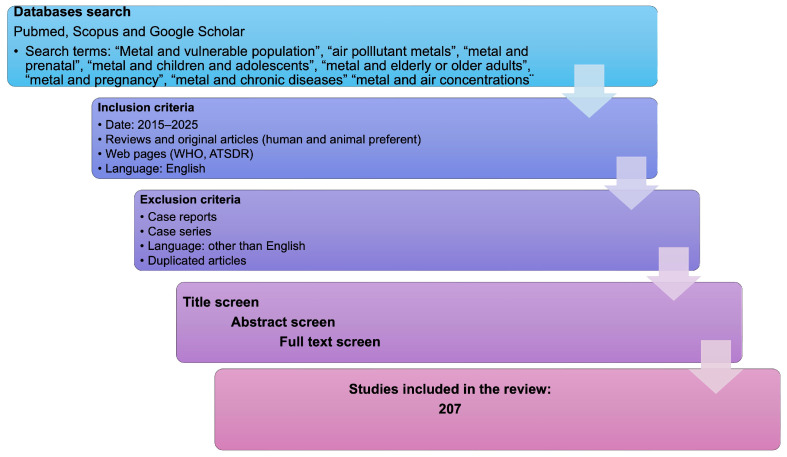 Figure 1
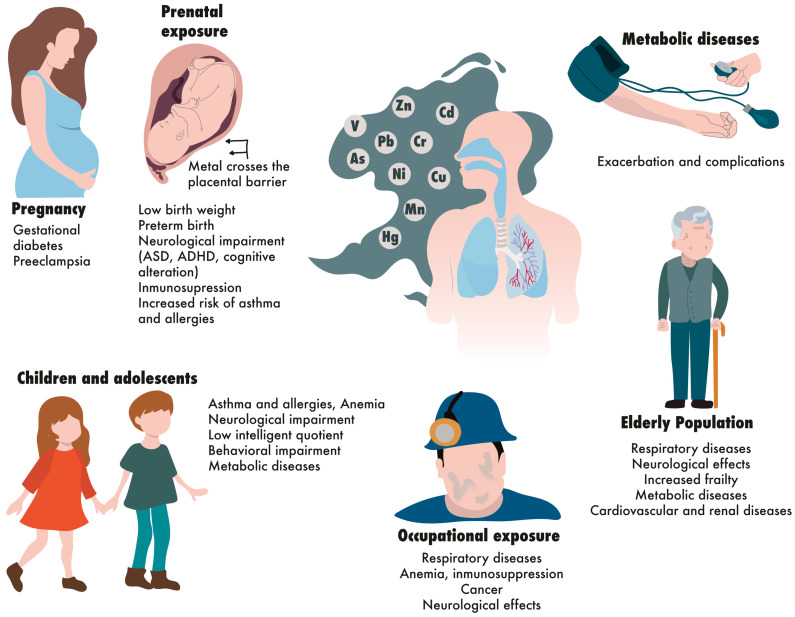 Figure 2
Peer Reviews
No public reviews on file for this paper yet. If you reviewed it on a platform where reviews are public (OpenReview, ICLR, NeurIPS, ICML), you can paste yours below so the community can read it here.
Videos
No videos yet. Explain this paper in a talk, walkthrough, or lecture? Add one.
Taxonomy
TopicsHeavy Metal Exposure and Toxicity · Heavy metals in environment · Trace Elements in Health