Travel-Associated Melioidosis in Non-Endemic Regions: A Systematic Review and Meta-Analysis
Jongkonnee Thanasai, Atthaphong Phongphithakchai, Moragot Chatatikun, Sa-ngob Laklaeng, Jitbanjong Tangpong, Pakpoom Wongyikul, Phichayut Phinyo, Supphachoke Khemla, Anchalee Chittamma, Wiyada Kwanhian Klangbud

TL;DR
Travel-associated melioidosis is a rare but serious infection in non-endemic regions, often contracted in Southeast Asia and presenting as lung disease or sepsis.
Contribution
This systematic review and meta-analysis identifies patterns and outcomes of imported melioidosis cases in non-endemic regions.
Findings
Most cases were acquired in Southeast Asia, particularly Thailand, and diagnosed in high-income countries like the Netherlands and France.
Pulmonary disease and sepsis were the most common clinical presentations, with a mortality rate of 12.6%.
Diabetes was the most frequent comorbidity, and relapse occurred in 7% of cases.
Abstract
Background: Travel-associated melioidosis, caused by Burkholderia pseudomallei, is increasingly reported in non-endemic countries due to rising global travel. Understanding demographic, clinical, and outcome patterns of imported cases is important to improve recognition and management in settings where melioidosis is uncommon. Methods: We systematically searched PubMed, Embase, and Scopus (last search: 24 September 2025) for case reports and case series of melioidosis diagnosed outside endemic regions and linked to travel exposure. Data were extracted on demographics, comorbidities, clinical manifestations, and outcomes. We performed descriptive analyses, subgroup analyses, and Firth’s penalized logistic regression to explore predictors of death. The protocol was registered in PROSPERO (CRD420251154559). Results: A total of 104 studies, encompassing 143 individual cases, were included.…
Genes, proteins, chemicals, diseases, species, mutations and cell lines named across the full text — each resolved to its canonical identifier and authoritative record.
Click any figure to enlarge with its caption.
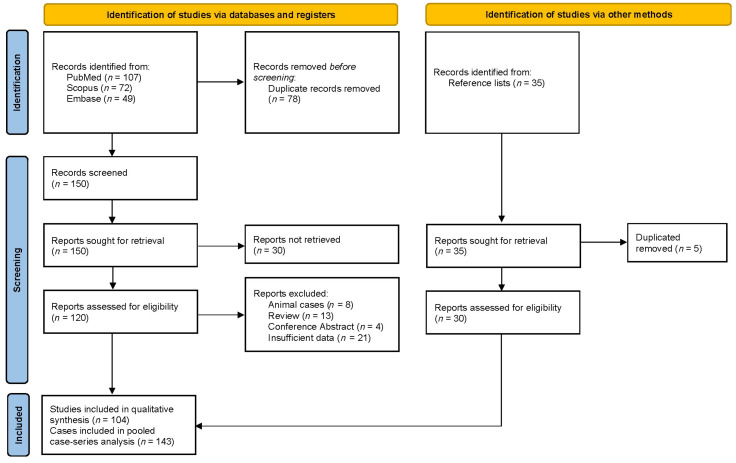 Figure 1
Peer Reviews
No public reviews on file for this paper yet. If you reviewed it on a platform where reviews are public (OpenReview, ICLR, NeurIPS, ICML), you can paste yours below so the community can read it here.
Videos
No videos yet. Explain this paper in a talk, walkthrough, or lecture? Add one.
Taxonomy
TopicsBurkholderia infections and melioidosis · Brucella: diagnosis, epidemiology, treatment · Research on Leishmaniasis Studies