Durability of Exercise vs. Revascularization in Intermittent Claudication: An Updated Meta-Analysis of Randomized Trials Focusing on Patient-Centered Outcomes
Mislav Puljevic, Petra Grubic-Rotkvic, Mia Dubravcic-Dosen, Andrija Stajduhar, Majda Vrkic-Kirhmajer

TL;DR
Exercise therapy provides long-lasting benefits for patients with intermittent claudication, while revascularization offers quicker relief but requires repeat procedures over time.
Contribution
An updated meta-analysis comparing the long-term durability of exercise therapy and revascularization for intermittent claudication.
Findings
Exercise therapy and revascularization both improve quality of life and walking distance at 12 months.
Exercise therapy provides sustained benefits beyond 24 months, while revascularization benefits decline due to restenosis.
Combining revascularization with exercise therapy yields better outcomes than exercise alone in the short term.
Abstract
Intermittent claudication (IC) is the most frequent symptomatic manifestation of lower-extremity peripheral artery disease (PAD). Supervised exercise therapy (SET) and endovascular revascularization (ER) are established treatments, but their relative and combined effects on health-related quality of life (HRQoL) remain. We conducted a systematic review and meta-analysis of randomized controlled trials (RCTs) comparing SET, ER, and ER+SET, with HRQoL as the primary outcome. Methods: Following PRISMA 2020, PubMed, Embase, and CENTRAL were used in December 2024. Eligible RCTs enrolled with IC (excluding critical limb-threatening ischemia) and reported validated HRQoL outcomes at ≥3 months. Two reviewers independently extracted data and assessed risk of bias using the Cochrane RoB 2.0 tool. Random-effects meta-analyses pooled standardized mean differences (SMDs) for HRQoL and mean…
Genes, proteins, chemicals, diseases, species, mutations and cell lines named across the full text — each resolved to its canonical identifier and authoritative record.
Click any figure to enlarge with its caption.
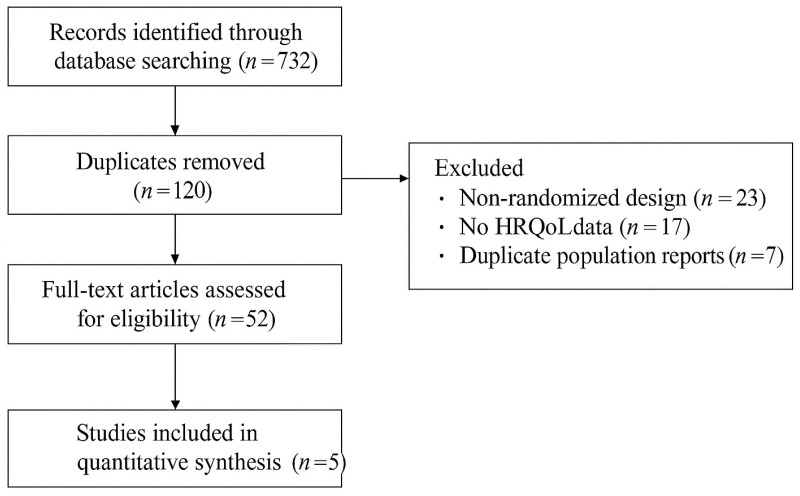 Figure 1
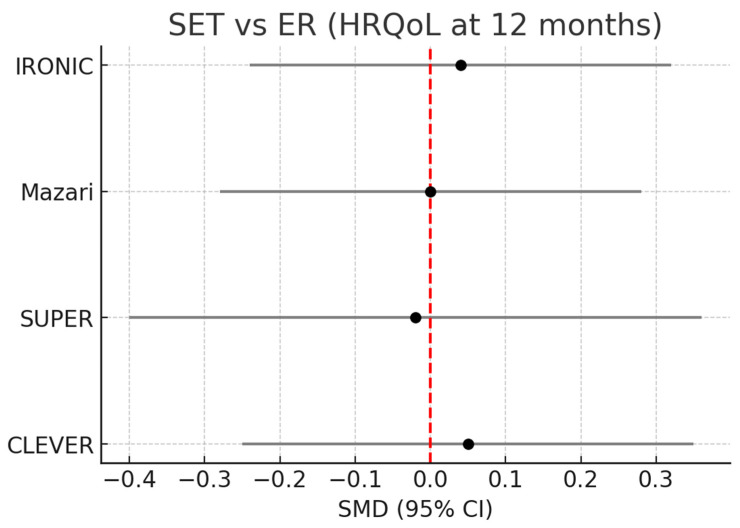 Figure 2
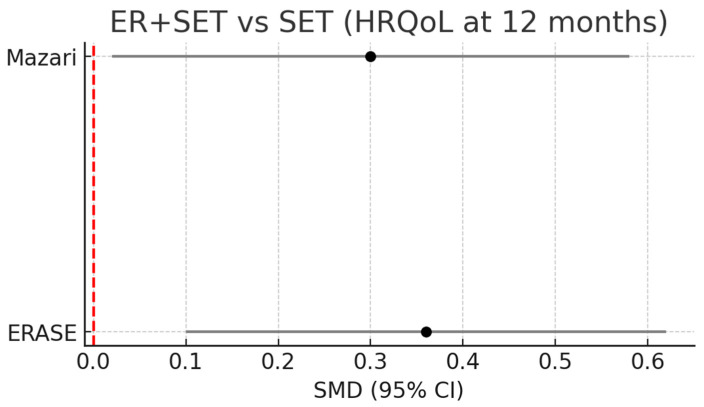 Figure 3
Peer Reviews
No public reviews on file for this paper yet. If you reviewed it on a platform where reviews are public (OpenReview, ICLR, NeurIPS, ICML), you can paste yours below so the community can read it here.
Videos
No videos yet. Explain this paper in a talk, walkthrough, or lecture? Add one.
Taxonomy
TopicsPeripheral Artery Disease Management · Diagnosis and Treatment of Venous Diseases · Renal and Vascular Pathologies