The Wafold: Curvature-Driven Termination and Dimensional Compression in Black Holes
Javier Viaña

TL;DR
This paper proposes a new geometric model of black holes where spacetime ends at a curvature-triggered boundary called the wafold, instead of a singularity.
Contribution
The novel concept is the wafold, a curvature-driven boundary where spatial dimensions compress into a surface, merging ideas from geometric compression and the holographic principle.
Findings
A dimensional conversion law is derived to describe how spatial volume collapses into surface area at the wafold.
The wafold is proposed as a terminal boundary where mass–energy and information are confined, eliminating the need for an interior singularity.
The model aligns with the holographic principle by suggesting information is encoded on the boundary rather than in the bulk.
Abstract
This work explores a geometric description of black holes in which spacetime terminates on a curvature-triggered hypersurface rather than extending to an interior singularity. We study the implications of a scenario in which, upon reaching a critical curvature threshold, the three-dimensional spatial geometry compresses into a thin, closed boundary identified here as the wafold. Beyond this, the manifold would no longer continue, and all mass–energy and information would be confined to the hypersurface itself. This framework combines two well-explored paths: (1) curvature-driven geometric compression, in which extreme curvature forces the bulk degrees of freedom to become supported on a thin hypersurface (without altering the underlying dimensionality of spacetime), and (2) the motivation underlying the holographic principle, namely that black-hole entropy scales with surface area…
Click any figure to enlarge with its caption.
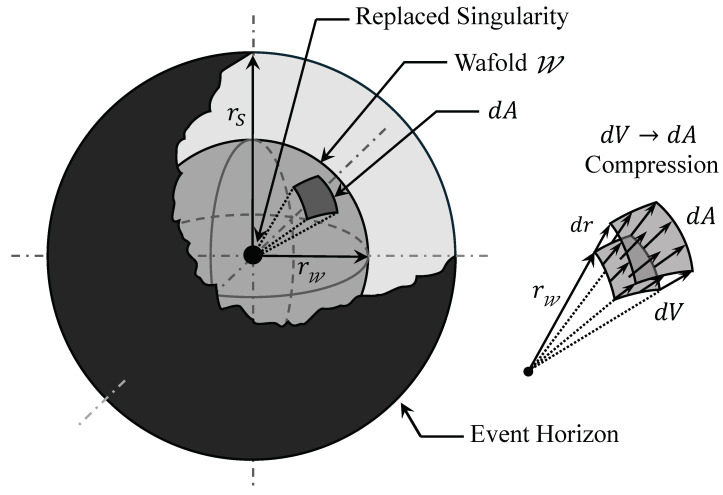 Figure 1
Peer Reviews
No public reviews on file for this paper yet. If you reviewed it on a platform where reviews are public (OpenReview, ICLR, NeurIPS, ICML), you can paste yours below so the community can read it here.
Videos
No videos yet. Explain this paper in a talk, walkthrough, or lecture? Add one.
Taxonomy
TopicsBlack Holes and Theoretical Physics · Astrophysical Phenomena and Observations · Quantum Electrodynamics and Casimir Effect