Antioxidant Performance and Characterization Comparison of Carbon Dots Derived from Agricultural Waste Pineapple Peel
Zhaoqi Pan, Yiyang Zhou, Binghong Ji, Qining Liu, Ziluan Fan

TL;DR
Researchers made carbon dots from pineapple peel waste using a microwave method and found they have strong antioxidant and antibacterial properties.
Contribution
The study introduces a novel eco-friendly method to produce antioxidant and antibacterial carbon dots from pineapple peel waste.
Findings
Pineapple peel-derived carbon dots (PP-CDs) showed strong free radical scavenging activity with DPPH and ABTS IC50 values.
Copper-doped and chitosan-doped CDs exhibited enhanced antibacterial activity against E. coli and S. aureus.
All CDs displayed yellow fluorescence under UV light, with PP-CDs showing the strongest intensity.
Abstract
This study prepared carbon dots (CDs) from agricultural waste pineapple peel via an eco-friendly microwave method, optimizing their performance through copper ion and chitosan doping. Multiple characterization techniques and performance tests were employed for systematic analysis. Antioxidant assays revealed that PP-CDs have excellent concentration-dependent free radical scavenging activity: the DPPH IC50 values of Pineapple Peel Carbon Dots (PP-CDs), Copper-Doped Pineapple Peel Carbon Dots (Cu-PP-CDs) and Chitosan-Doped Pineapple Peel Carbon Dots (CS-PP-CDs) are 0.79, 0.95 and 0.98 mg/mL, while their ABTS IC50 values are 0.22, 0.40 and 0.26 mg/mL, respectively. Antibacterial tests showed modified CDs have enhanced activity: Cu-PP-CDs exhibit inhibition zones of 23.1 ± 0.13 mm (E. coli) and 17.3 ± 0.05 mm (S. aureus) with MICs of 2.5 and 5.0 mg/mL, while CS-PP-CDs have respective zones…
Genes, proteins, chemicals, diseases, species, mutations and cell lines named across the full text — each resolved to its canonical identifier and authoritative record.
Click any figure to enlarge with its caption.
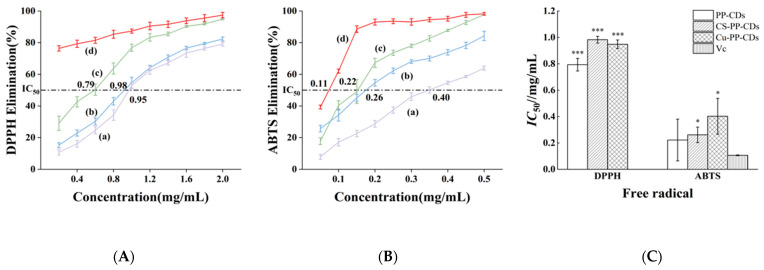 Figure 1
 Figure 2
 Figure 3
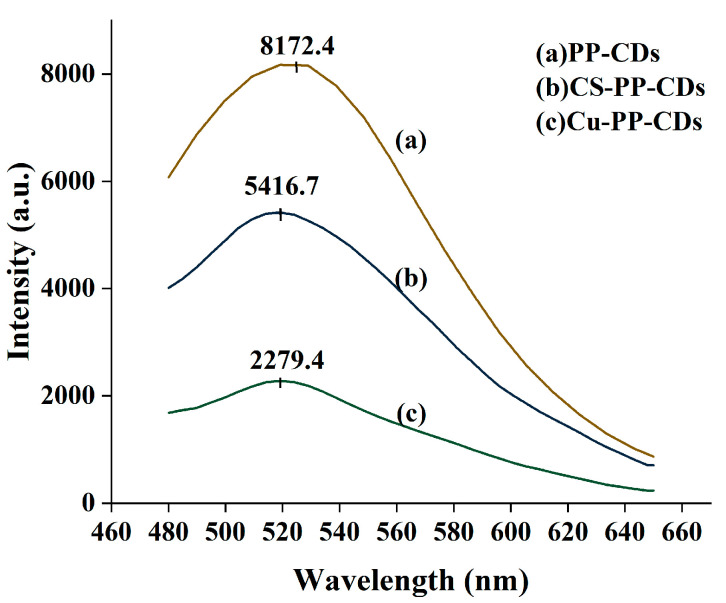 Figure 4
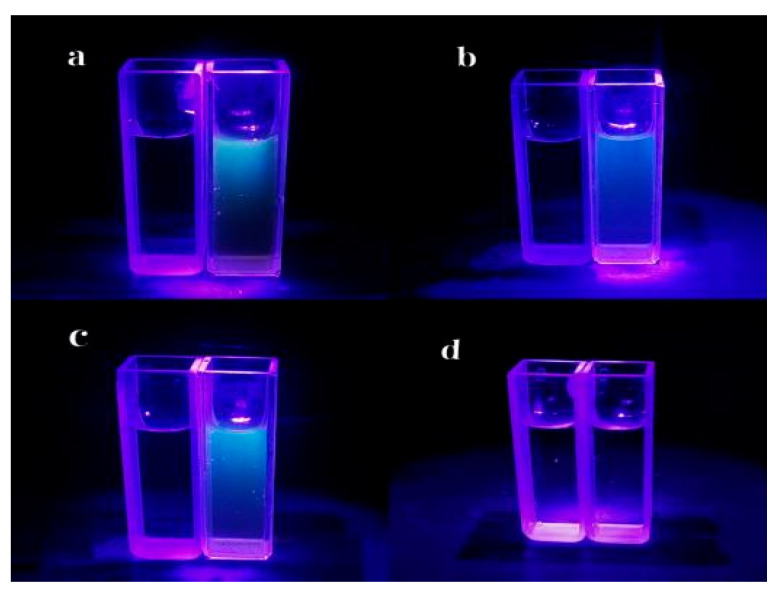 Figure 5
 Figure 6
 Figure 7
Peer Reviews
No public reviews on file for this paper yet. If you reviewed it on a platform where reviews are public (OpenReview, ICLR, NeurIPS, ICML), you can paste yours below so the community can read it here.
Videos
No videos yet. Explain this paper in a talk, walkthrough, or lecture? Add one.
Taxonomy
TopicsCarbon and Quantum Dots Applications · Electrochemical sensors and biosensors · Dye analysis and toxicity