Prevalence, Spectrum, and Management of Thyroid Dysfunction in Children with Down Syndrome: A Retrospective Study from Southern Saudi Arabia
Youssef Ali Alqahtani, Ayed A. Shati, Ayoub Ali Alshaikh, Ali Thamer Alshahrani, Salwa Abdullah Bin Qaed, Manar Ali Alqahtani, Omar Ayidh Alotaibi, Muteb Obaid Alharthi, Mohamed Hassan Sarhan, Abdulaziz Mohammed Alrasheed, Ramy Mohamed Ghazy

TL;DR
Children with Down syndrome in southern Saudi Arabia have a high rate of thyroid issues, especially subclinical and autoimmune hypothyroidism, and many need better treatment adjustments.
Contribution
This study identifies subclinical hypothyroidism as the most common thyroid dysfunction in Saudi children with Down syndrome and highlights poor treatment optimization despite high screening rates.
Findings
Thyroid dysfunction prevalence was 52.8%, with subclinical hypothyroidism being the most common type.
74.4% of levothyroxine-treated patients likely needed dose adjustment, indicating suboptimal therapeutic management.
A positive family history of thyroid disease increased risk more than fourfold (adjusted odds ratio = 4.57).
Abstract
This study found a high prevalence of thyroid dysfunction among Saudi children with Down syndrome, mainly subclinical hypothyroidism followed by autoimmune hypothyroidism. Affected children had more clinical manifestations—especially metabolic, dermatological, and gastrointestinal—than those without thyroid dysfunction. A positive family history of thyroid disease was the strongest predictor, increasing the risk more than fourfold. Despite high screening coverage and generally guideline-consistent follow-up, therapeutic management was suboptimal: around three-fourths of levothyroxine-treated patients likely needed dose adjustment. These findings highlight the need for better dose optimization, standardized diagnostic algorithms, and stronger long-term surveillance in this high-risk group. What are the main findings? Thyroid dysfunction is very common, mainly subclinical and autoimmune…
Genes, proteins, chemicals, diseases, species, mutations and cell lines named across the full text — each resolved to its canonical identifier and authoritative record.
Click any figure to enlarge with its caption.
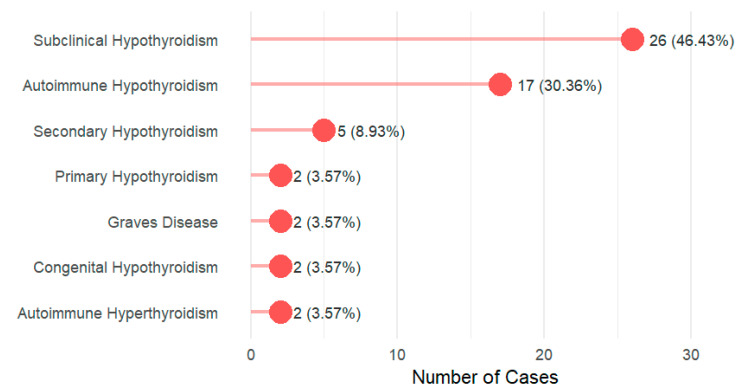 Figure 1
Peer Reviews
No public reviews on file for this paper yet. If you reviewed it on a platform where reviews are public (OpenReview, ICLR, NeurIPS, ICML), you can paste yours below so the community can read it here.
Videos
No videos yet. Explain this paper in a talk, walkthrough, or lecture? Add one.
Taxonomy
TopicsDown syndrome and intellectual disability research · Thyroid Disorders and Treatments · Diabetes and associated disorders