A Pedagogical Reinforcement of the Ideal (Hard Sphere) Gas Using a Lattice Model: From Quantized Volume to Mechanical Equilibrium
Rodrigo de Miguel

TL;DR
This paper uses a lattice model to explain the ideal gas law and thermodynamic concepts without relying on traditional assumptions about particle density or size.
Contribution
A novel lattice-based derivation of the ideal gas law that avoids assumptions about lattice size or density.
Findings
The ideal gas law can be derived from a lattice model without assuming low particle density.
A statistical mechanical analysis with quantized volume aligns with the lattice model's results.
The model provides insights into the assumptions behind thermodynamic laws and equilibrium processes.
Abstract
Due to their simplicity and ease of visualization, lattice models can be useful to illustrate basic concepts in thermodynamics. The recipe to obtain classical thermodynamic expressions from lattice models is usually based on invoking the thermodynamic limit, and the ideal gas law can easily be obtained as the density of non-interacting particles vanishes. We present a lattice-based analysis that shows that, when a gas consisting of non-interacting particles evolves towards mechanical equilibrium with the environment, the ideal gas law can be obtained with no recourse to unnecessary assumptions regarding the size or particle density of the lattice. We also present a statistical mechanical analysis that considers a quantized volume and reproduces the process obtained for the discrete lattice model. We show how the alternative use of a well-known and accessible model (the non-interacting…
Click any figure to enlarge with its caption.
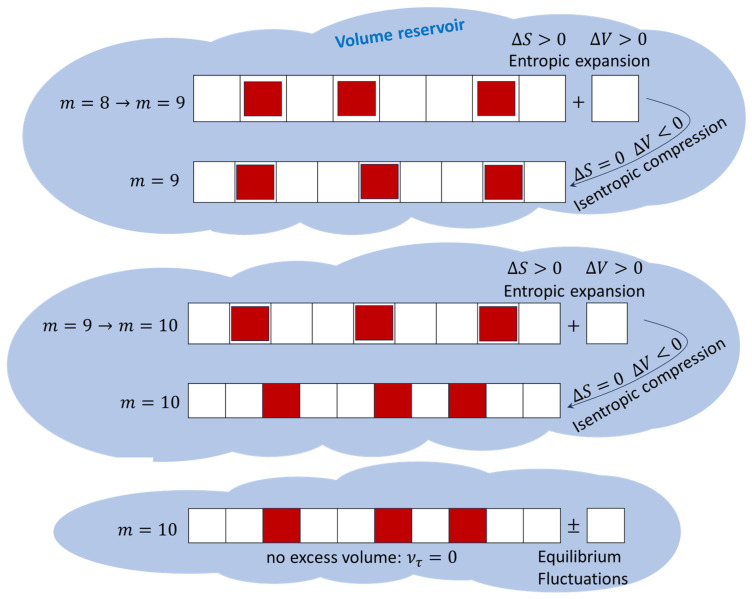 Figure 1
Peer Reviews
No public reviews on file for this paper yet. If you reviewed it on a platform where reviews are public (OpenReview, ICLR, NeurIPS, ICML), you can paste yours below so the community can read it here.
Videos
No videos yet. Explain this paper in a talk, walkthrough, or lecture? Add one.
Taxonomy
TopicsPhase Equilibria and Thermodynamics · Advanced Physical and Chemical Molecular Interactions · Advanced Thermodynamics and Statistical Mechanics