“Why Are You Happy if Your Dad Died?”: The Social Experiences of Parentally Bereaved Children in Elementary and Middle Schools
Yael Boutton-Laor, Yulia Muchnik-Rozanov, Rivi Frei-Landau

TL;DR
This study explores how children who have lost a parent experience social support in school, revealing a range of peer responses from supportive to harmful.
Contribution
The study provides new qualitative insights into the social experiences of parentally bereaved children in Israeli schools.
Findings
Peer support for bereaved children ranges from supportive to teasing behaviors.
Social responses significantly affect children's sense of belonging and grief expression.
Findings suggest a need for school-based training to improve support for bereaved children.
Abstract
Background: Parental loss in childhood is a significant developmental risk factor, underscoring the need for evidence-based knowledge to guide support. Although social responses play a central role in children’s adjustment to loss, little is known about how parentally bereaved children in Israel experience social support in school. Methods: This qualitative study examined how parentally bereaved children in elementary and middle school experience social responses in the school context. Thirty-six participants were interviewed: 20 children who participated in dyadic interviews with their 16 surviving parents. Linguistic analysis, combined with Grounded Theory, was used to analyze the data. Results: Peer support was found to lie on a continuum ranging from support, through an unintentional lack of support, to deliberate nonsupport (teasing). These patterns shaped children’s experiences of…
Click any figure to enlarge with its caption.
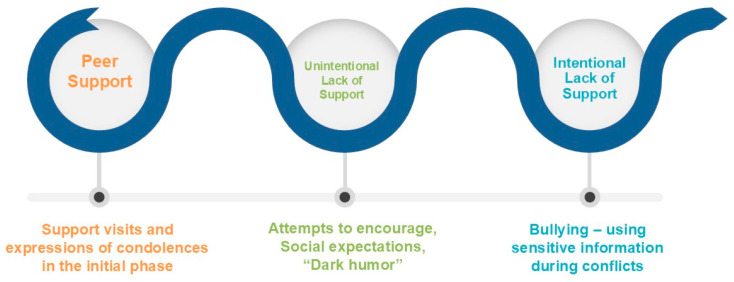 Figure 1
Peer Reviews
No public reviews on file for this paper yet. If you reviewed it on a platform where reviews are public (OpenReview, ICLR, NeurIPS, ICML), you can paste yours below so the community can read it here.
Videos
No videos yet. Explain this paper in a talk, walkthrough, or lecture? Add one.
Taxonomy
TopicsGrief, Bereavement, and Mental Health · Family Support in Illness · Resilience and Mental Health