Adrenal Venous Sampling Aids in Distinguishing 17-Hydroxyprogesterone Hypersecreting Adrenal Cortical Adenomas from Non-Classical 21-Hydroxylase Deficiency
Ruojun Qiu, Tian Yang, Chengxin Shang, Weifen Zhu, Fenping Zheng

TL;DR
A case study shows that adrenal venous sampling can help distinguish adrenal tumors from non-classical 21-hydroxylase deficiency by identifying 17-hydroxyprogesterone hypersecretion.
Contribution
This case introduces a new diagnostic approach using adrenal venous sampling to differentiate adrenal tumors from non-classical 21-hydroxylase deficiency.
Findings
Adrenal venous sampling confirmed lateralized 17-hydroxyprogesterone hypersecretion from a left adrenal tumor.
Postoperative normalization of 17-hydroxyprogesterone levels supported the tumor diagnosis.
Transcriptomic profiling suggested microRNA-related and PI3K-Akt pathway involvement in tumor pathogenesis.
Abstract
Background and Clinical Significance: This report presents the case of a 33-year-old female with recurrent miscarriage, investigated for an adrenal cortical adenoma characterized by autonomous secretion of 17-hydroxyprogesterone (17-OHP). The findings challenge the established diagnostic paradigm, which predominantly attributes elevated serum 17-OHP to congenital adrenal hyperplasia (CAH) or non-classical CAH (NCCAH). Case Presentation: The patient was found to have elevated serum 17-OHP and a 2 cm left adrenal mass. Normal testosterone and precursor levels, along with whole-exome sequencing (WES), argued against a diagnosis of non-classical 21-hydroxylase deficiency (NC-21OHD). An ACTH stimulation test elicited a mild-to-moderate rise in 17-OHP, while adrenal venous sampling (AVS) confirmed marked lateralization of 17-OHP hypersecretion to the left side. Postoperative normalization of…
Genes, proteins, chemicals, diseases, species, mutations and cell lines named across the full text — each resolved to its canonical identifier and authoritative record.
Click any figure to enlarge with its caption.
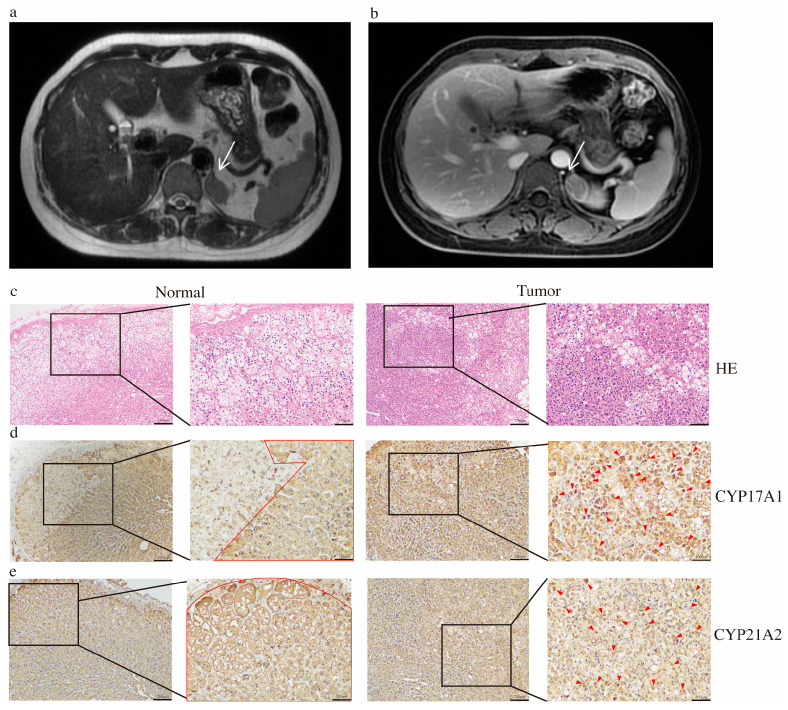 Figure 1
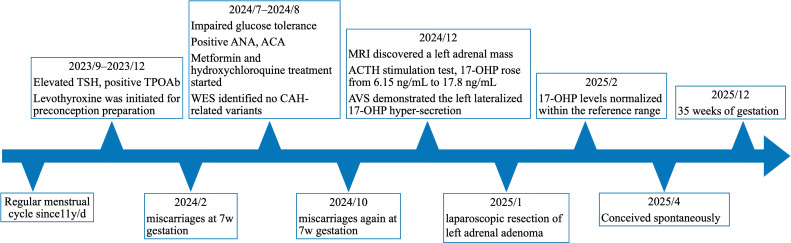 Figure 2
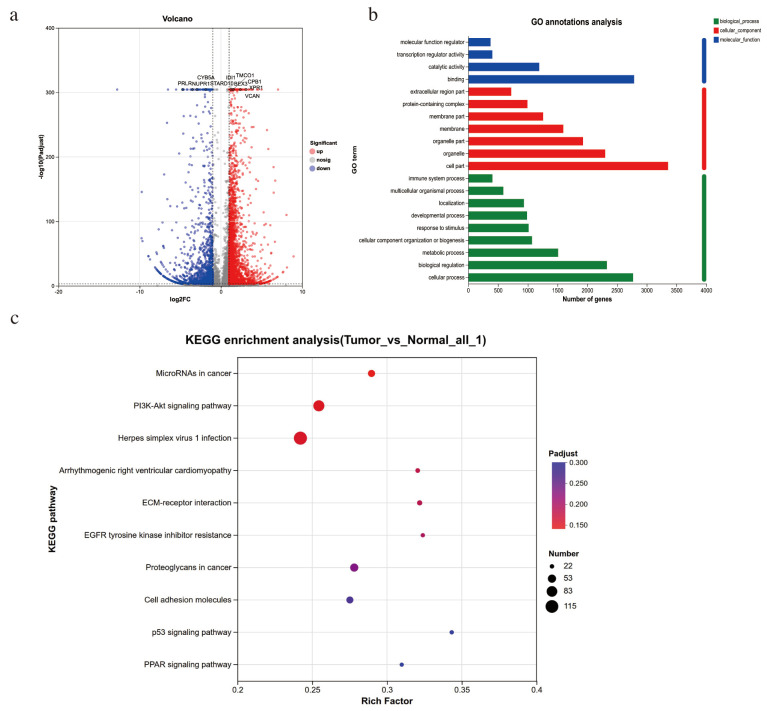 Figure 3
Peer Reviews
No public reviews on file for this paper yet. If you reviewed it on a platform where reviews are public (OpenReview, ICLR, NeurIPS, ICML), you can paste yours below so the community can read it here.
Videos
No videos yet. Explain this paper in a talk, walkthrough, or lecture? Add one.
Taxonomy
TopicsSexual Differentiation and Disorders · Adrenal and Paraganglionic Tumors · Genetic and Clinical Aspects of Sex Determination and Chromosomal Abnormalities