Thermodynamic Operations and Entropy Considerations for a Ring-of-Charge Oscillator System
Daniel C. Cole

TL;DR
This paper explores the thermodynamics of a charged particle oscillating within a ring of charge, deriving radiation spectra and entropy laws.
Contribution
The paper derives the classical electromagnetic zero-point radiation spectrum and extends the Wien displacement law to include zero-point radiation.
Findings
The average internal energy and work done on the particle are calculated as the ring's radius changes.
The Wien displacement law is derived with inclusion of zero-point radiation.
Thermodynamic temperature calculations are discussed in the context of the system.
Abstract
A ring of classical charge with a charged point particle oscillating within is first analyzed. The charged particle interacts with classical electromagnetic thermal radiation, which causes the particle to fluctuate, while the ring of charge imparts a resonant frequency to the particle’s motion. Oscillations in one direction within the plane of the ring are analyzed. The radius of the ring is slowly altered. The accompanying change in the particle’s average internal energy and the average work done in changing the radius are calculated. This leads to a derivation of the classical electromagnetic zero-point radiation spectrum. Next, the second law of thermodynamics is applied to the entropy to enable a more general derivation of the Wien displacement law. With this derivation, zero-point radiation can be included in the Wien displacement law. Finally the definition of the thermodynamic…
Click any figure to enlarge with its caption.
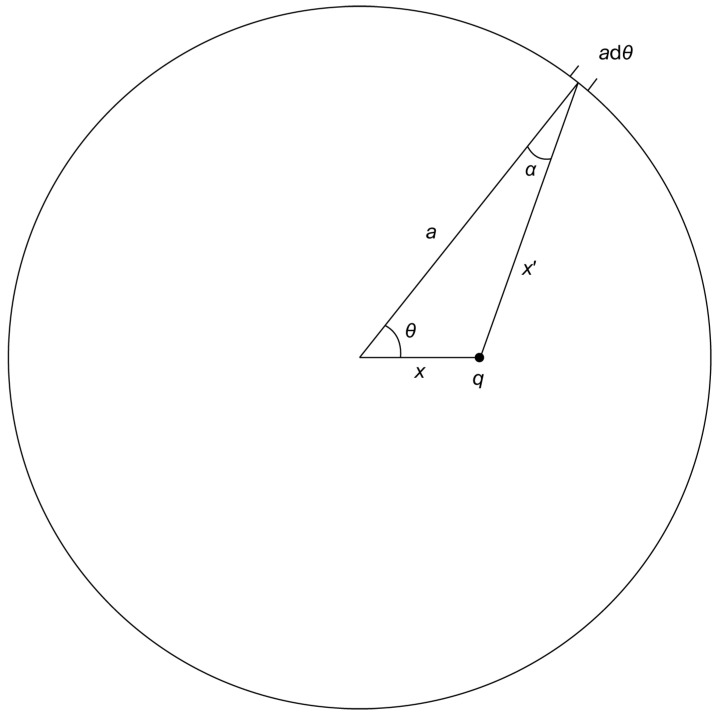 Figure 1
Peer Reviews
No public reviews on file for this paper yet. If you reviewed it on a platform where reviews are public (OpenReview, ICLR, NeurIPS, ICML), you can paste yours below so the community can read it here.
Videos
No videos yet. Explain this paper in a talk, walkthrough, or lecture? Add one.
Taxonomy
TopicsQuantum and Classical Electrodynamics · Particle Accelerators and Free-Electron Lasers · Electromagnetic Scattering and Analysis