Comparative Evidence-Based Model Choice: A Sketch of a Theory
Prasanta S. Bandyopadhyay, Samidha Shetty, Gordon Brittan

TL;DR
The paper introduces a non-subjective framework for model choice that integrates prediction and explanation using comparative evidence-based methods.
Contribution
It proposes a new non-subjective comparative evidence-based model choice (CEMC) framework for epistemic utility.
Findings
CEMC integrates prediction and explanation through comparative model assessment.
Statistical tools for measuring epistemic utility are identified within the CEMC framework.
CEMC contrasts with non-comparative approaches like interval-based probability.
Abstract
An extensive literature on decision theory has been developed by both subjective Bayesians and Neyman–Pearson (NP) theorists, with more recent contributions to it from evidential decision theorists. The last-mentioned, however, have often been framed from a Bayesian perspective and therefore retain a subjectivist orientation. By contrast, we advance a comparative evidence-based model choice (CEMC) account of epistemic utility, which is explicitly non-subjective. On this account, competing models are assessed by the degree to which they are supported by the data and relevant background information, and evaluated comparatively in terms of their relative distances. CEMC thus provides a philosophical framework for inference that integrates the complementary epistemic goals of prediction and explanation. Our approach proceeds in two stages. First, we articulate a framework for…
Click any figure to enlarge with its caption.
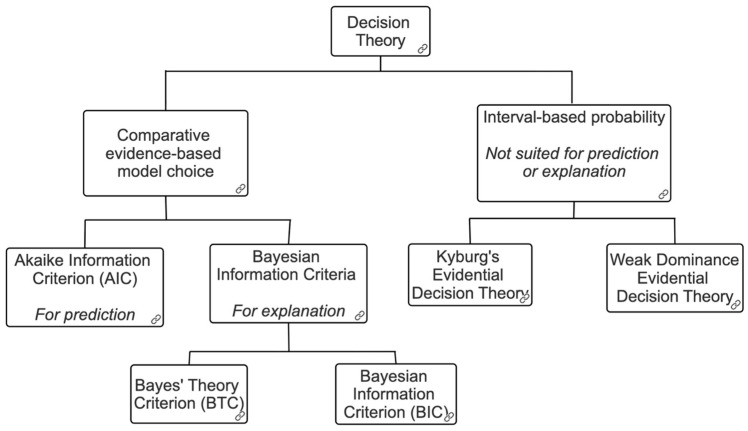 Figure 1
Peer Reviews
No public reviews on file for this paper yet. If you reviewed it on a platform where reviews are public (OpenReview, ICLR, NeurIPS, ICML), you can paste yours below so the community can read it here.
Videos
No videos yet. Explain this paper in a talk, walkthrough, or lecture? Add one.
Taxonomy
TopicsEpistemology, Ethics, and Metaphysics · Philosophy and History of Science · Bayesian Modeling and Causal Inference