Clinicopathologic Features and Postoperative Outcomes of Parotidectomy: A 16-Year Retrospective Cohort Study from a Tertiary Referral Center
Seval Akay, Ozlem Yagiz Agayarov, Volkan Semiz, Ulku Kucuk, Ilker Burak Arslan, Olcun Umit Unal, Ibrahim Cukurova

TL;DR
This study analyzed 314 parotidectomy cases over 16 years to understand tumor types and outcomes, focusing on facial nerve function and risk factors for complications.
Contribution
The study introduces a risk-stratified follow-up approach based on histopathologic features to improve postoperative care for parotidectomy patients.
Findings
Malignant tumors were linked to higher surgical margin positivity, capsular invasion, and tumor necrosis compared to benign tumors.
Facial nerve paralysis was more common in malignant cases and after extensive lymph node dissection.
Benign tumors like pleomorphic adenoma occasionally showed aggressive features such as capsular invasion and necrosis.
Abstract
Background: Parotid gland tumors pose diagnostic and surgical challenges due to their histological heterogeneity and proximity to the facial nerve. This study aimed to evaluate clinicopathological features and postoperative outcomes with a specific focus on facial nerve function in patients undergoing parotidectomy. Methods: This retrospective study included 314 patients who underwent parotidectomy between 2008 and 2024 at a tertiary center. Demographic data, tumor histology, and postoperative complications—particularly facial nerve paralysis within the first three months—were analyzed. Histopathological features including capsular, perineural, and lymphovascular invasion were also assessed. Results: Of all cases, 79% were benign, 14.6% malignant, and 6.4% non-neoplastic. Pleomorphic adenoma and Warthin tumor were the most common benign entities, while mucoepidermoid carcinoma was the…
Genes, proteins, chemicals, diseases, species, mutations and cell lines named across the full text — each resolved to its canonical identifier and authoritative record.
Click any figure to enlarge with its caption.
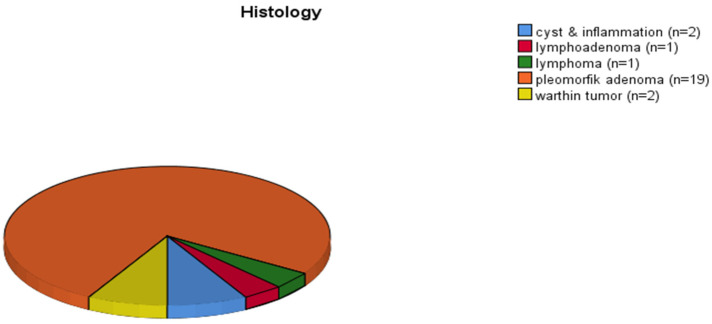 Figure 1
Peer Reviews
No public reviews on file for this paper yet. If you reviewed it on a platform where reviews are public (OpenReview, ICLR, NeurIPS, ICML), you can paste yours below so the community can read it here.
Videos
No videos yet. Explain this paper in a talk, walkthrough, or lecture? Add one.
Taxonomy
TopicsSalivary Gland Tumors Diagnosis and Treatment · Ear and Head Tumors · Facial Nerve Paralysis Treatment and Research