Construction of N/S CQDs@Fe-TCPP Nanocatalyst-Induced Electrochemical Sensors for Rapid and Sensitive Detection of Enrofloxacin Residues in Milk
Wenjing Wang, Shujuan Chen, Yifan Fu, Yike Hong, Chenbo Tang, Likou Zou, Junni Tang, Li He, Shuliang Liu, Kaidi Hu, Aiping Liu

TL;DR
A new electrochemical sensor was developed to quickly and accurately detect enrofloxacin residues in milk using a nanocatalyst composite.
Contribution
The novel N/S CQDs@Fe-TCPP composite enables sensitive and stable detection of enrofloxacin in food samples.
Findings
The sensor detected enrofloxacin in the range of 1–1300 nM with a detection limit of 0.872 nM.
The sensor showed a recovery rate of 99.02% to 100.9% in milk samples and high reproducibility (RSD of 1.27%).
The system retained 93.51% peak current after 21 days, indicating strong stability.
Abstract
Given the potential hazards of enrofloxacin (ENR) residues to human health, establishing an accurate, rapid, and stable detection method is of importance. To enable the direct detection of ENR, an electrochemical sensor was constructed in this study. N- and S-doped carbon quantum dots (CQDs) with peroxidase-like activity were prepared using DL-malic acid, L-alanine, and L-cysteine as precursors and compounded with a tetrakis (4-carboxyphenyl) porphyrin (TCPP) and Fe(NO3)3·9H2O to make novel N/S CQDs@Fe-TCPP composite carbon-based nanozymes to construct an electrochemical sensor, and the electrochemical behavior was investigated. Under optimal experimental conditions, the sensor exhibited a linear current response to ENR concentrations in the range of 1–1300 nM (I (μA) = 0.0106c (nM) + 2.9861, R2 = 0.9962), with a calculated detection limit of 0.872 nM (S/N = 3). The recovery rate of…
Genes, proteins, chemicals, diseases, species, mutations and cell lines named across the full text — each resolved to its canonical identifier and authoritative record.
Click any figure to enlarge with its caption.
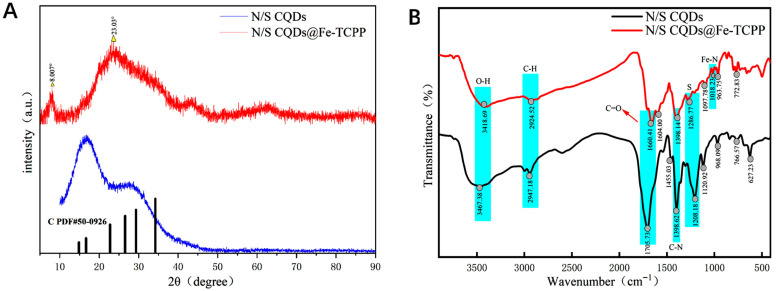 Figure 1
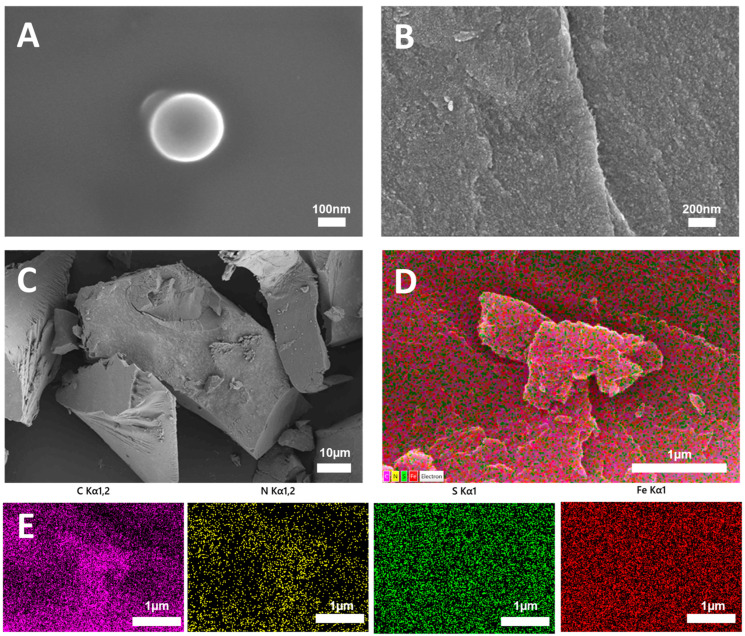 Figure 2
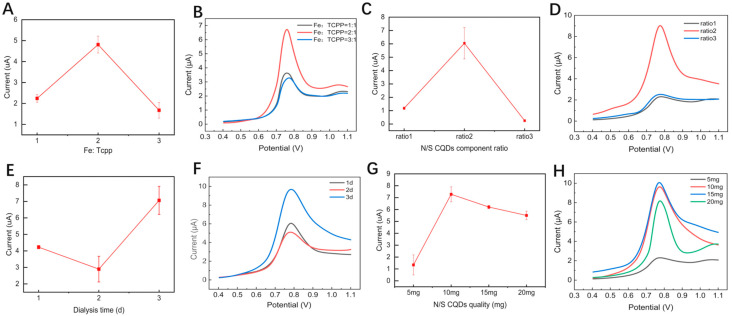 Figure 3
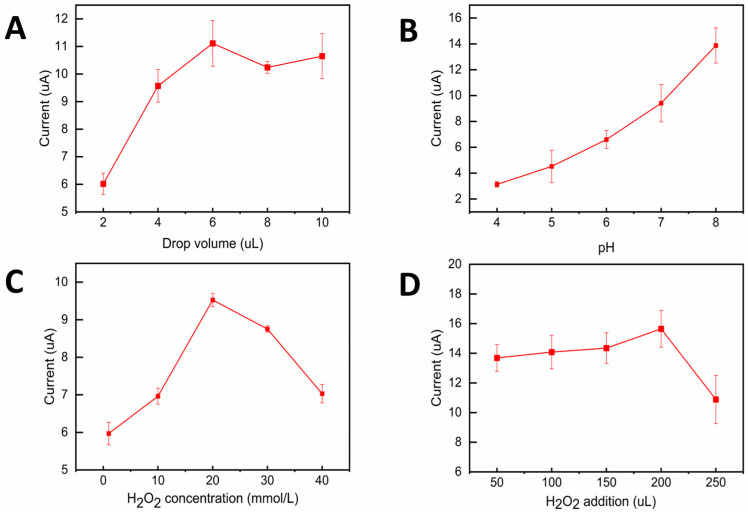 Figure 4
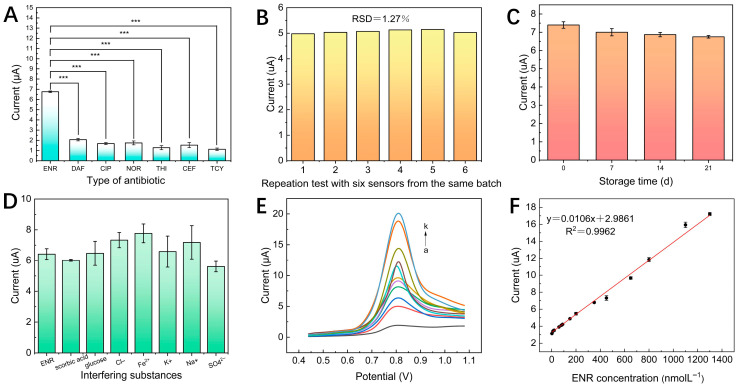 Figure 5
Peer Reviews
No public reviews on file for this paper yet. If you reviewed it on a platform where reviews are public (OpenReview, ICLR, NeurIPS, ICML), you can paste yours below so the community can read it here.
Videos
No videos yet. Explain this paper in a talk, walkthrough, or lecture? Add one.
Taxonomy
TopicsAdvanced Nanomaterials in Catalysis · Electrochemical sensors and biosensors · Advanced biosensing and bioanalysis techniques