“Vox Populi” Fractional Flow Reserve (vpFFR)—Leveraging Wisdom of the Crowd for the Assessment of Hemodynamic Severity of Intermediate Coronary Lesions
Natalija Odanovic, Vojko Misevic, Aleksa Obradovic, Vanja Bojic, Kosta Krupnikovic, Aleksandar Mandic, Matija Furtula, Dusan Borzanovic, Nikola Lazarevic, Stefan Zivkovic, Ivan Ilic, Milan Dobric, Samit M. Shah

TL;DR
This study introduces a new method called vpFFR that uses averaged human predictions to assess heart artery blockages more accurately than existing methods.
Contribution
The novel vpFFR method leverages crowd-sourced human predictions to outperform 2D and 3D QCA in diagnosing coronary lesion severity.
Findings
vpFFR showed a 73% accuracy in classifying lesion severity, better than 65% and 51% for 2D and 3D QCA.
vpFFR had a correlation coefficient of 0.56 with invasive FFR, significantly higher than 2D-QCA (−0.26) and 3D-QCA (−0.01).
Abstract
Background/Objectives: Diagnostic performance of angiography-derived physiological measures has been benchmarked against two-dimensional (2D) and three-dimensional (3D) quantitative coronary angiography (QCA), which are known for their poor correlation with hemodynamic lesion severity. Relying on the statistical concept of the wisdom of the crowd, we devised a human-performance reference for FFR surrogates, called vox populi FFR (vpFFR), and examined the comparative diagnostic performance of vpFFR, as well as 2D- and 3D-QCA, using invasively measured FFR as the gold standard. Methods: Analyses were performed in a single-center, prospective registry of consecutive FFR procedures. We calculated vpFFR as a mean of five independent, blinded predictions of the invasively measured FFR. Pearson’s correlation coefficient and receiver operating characteristic (ROC) curve analyses were used for…
Genes, proteins, chemicals, diseases, species, mutations and cell lines named across the full text — each resolved to its canonical identifier and authoritative record.
Click any figure to enlarge with its caption.
 Figure 1
 Figure 2
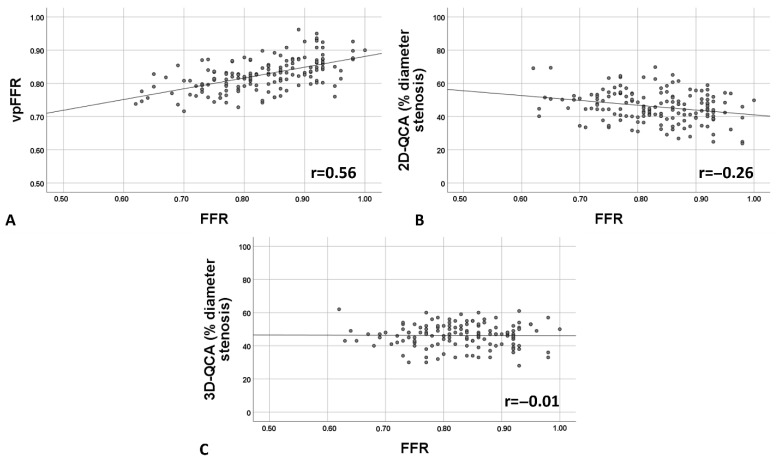 Figure 3
 Figure 4
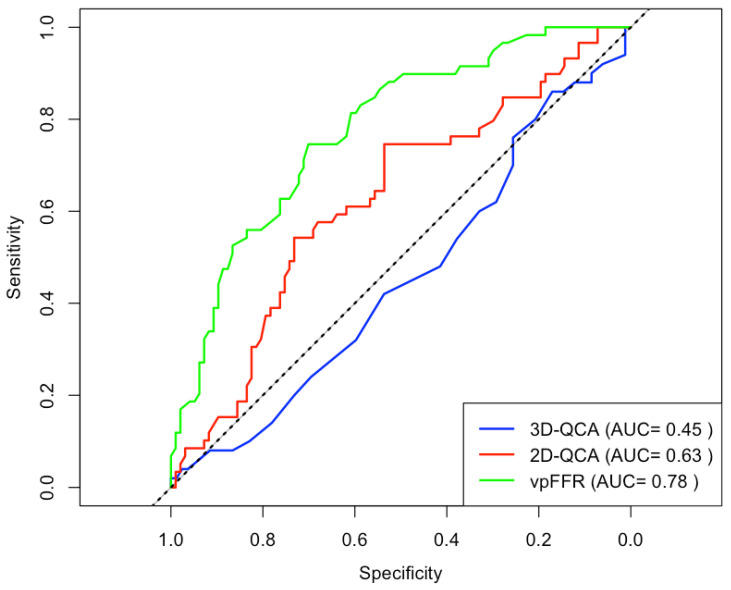 Figure 5
Peer Reviews
No public reviews on file for this paper yet. If you reviewed it on a platform where reviews are public (OpenReview, ICLR, NeurIPS, ICML), you can paste yours below so the community can read it here.
Videos
No videos yet. Explain this paper in a talk, walkthrough, or lecture? Add one.
Taxonomy
TopicsCoronary Interventions and Diagnostics · Cardiac Imaging and Diagnostics · Cerebrovascular and Carotid Artery Diseases