Unifying Kibble–Zurek Mechanism in Weakly Driven Processes
Pierre Nazé

TL;DR
This paper introduces a new framework for the Kibble-Zurek mechanism that eliminates the need for ad hoc assumptions while preserving key characteristics.
Contribution
A new framework is introduced that unifies the Kibble-Zurek mechanism without relying on ad hoc hypotheses.
Findings
The Kibble-Zurek scaling for excess work is approximately 2/5.
The result applies to both open and thermally isolated systems.
The framework is demonstrated using four distinct scaling functions.
Abstract
A description of the Kibble–Zurek mechanism with linear response theory has been done previously, but ad hoc hypotheses were used, such as the rate-dependent impulse window via the Zurek equation in the context of no driving in the relaxation time. In this work, I present a new framework where such hypotheses are unnecessary while preserving all the characteristics of the phenomenon. The Kibble-Zurek scaling obtained for the excess work is close to 2/5, a result that holds for open and thermally isolated systems with relaxation time that diverges at the critical point and the first zero of the relaxation function is finite. I exemplify the results using four different but significant types of scaling functions.
Click any figure to enlarge with its caption.
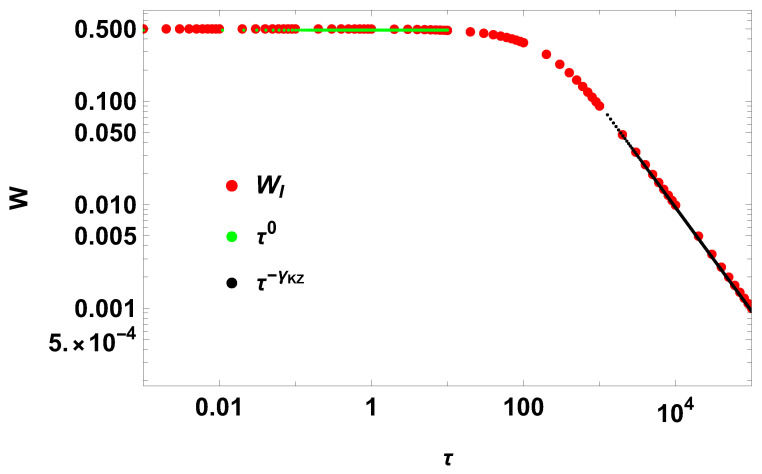 Figure 1
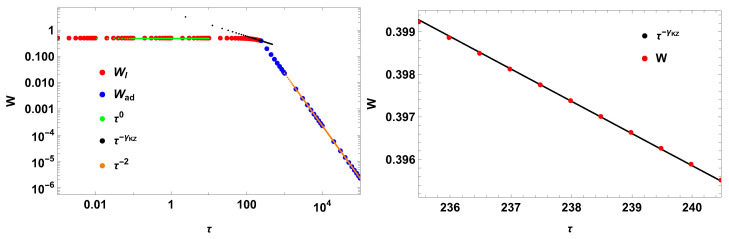 Figure 2
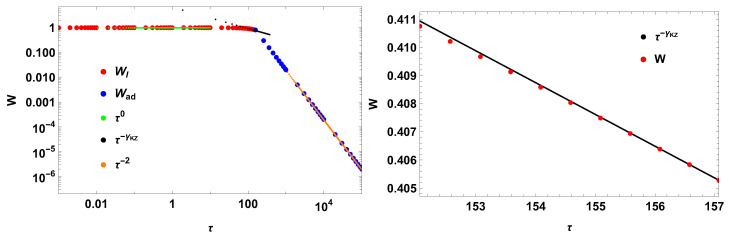 Figure 3
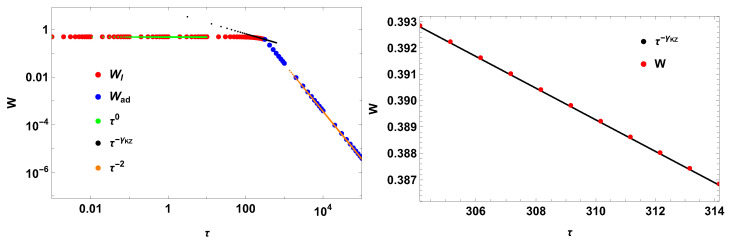 Figure 4
Peer Reviews
No public reviews on file for this paper yet. If you reviewed it on a platform where reviews are public (OpenReview, ICLR, NeurIPS, ICML), you can paste yours below so the community can read it here.
Videos
No videos yet. Explain this paper in a talk, walkthrough, or lecture? Add one.
Taxonomy
TopicsAdvanced Thermodynamics and Statistical Mechanics · Theoretical and Computational Physics · Nonlinear Dynamics and Pattern Formation