Remarks on a Scaling Theory of Spread of COVID-19 with an Application to the Case of Bulgaria
Svetlan Kartalov, Nikolay K. Vitanov

TL;DR
The paper explores how the spread of COVID-19 in Bulgaria follows a scaling pattern similar to urban dynamics, suggesting a mathematical model to describe it.
Contribution
The novelty lies in applying scaling theory from urban dynamics to model the spread of a pandemic, validated with Bulgarian data.
Findings
The number of infected people in Bulgarian regions follows a power-law dependence on the homochrony number.
Real data from the first wave of the pandemic collapses onto a single straight line, supporting the mathematical model.
Abstract
We present several remarks on the spread of the COVID-19 epidemics in Bulgaria. The remarks are based on the hypothesis that the spread of the infection exhibits scaling properties similar to the scaling in urban dynamics. The corresponding mathematical theory leads us to a relationship for a power-law dependence of the number of infected in a certain region on the corresponding homochrony number. We prove the correctness of the mathematical theory on the basis of data for several Bulgarian regions for the first large COVID-19 wave in 2020. We observe a collapse of the real data along a single straight line.
Genes, proteins, chemicals, diseases, species, mutations and cell lines named across the full text — each resolved to its canonical identifier and authoritative record.
Click any figure to enlarge with its caption.
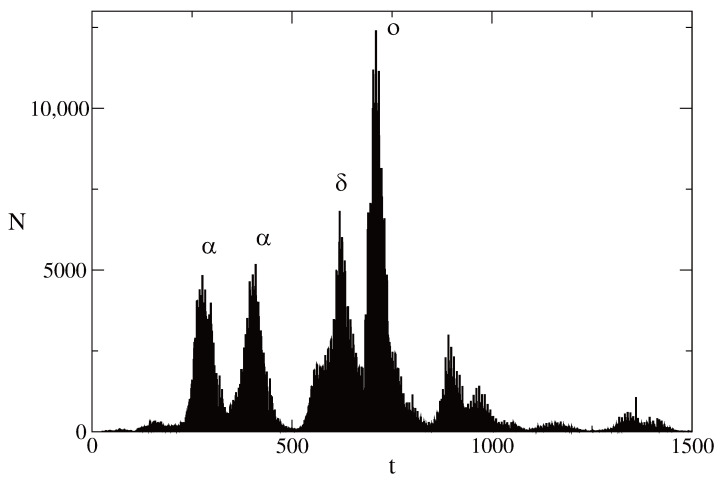 Figure 1
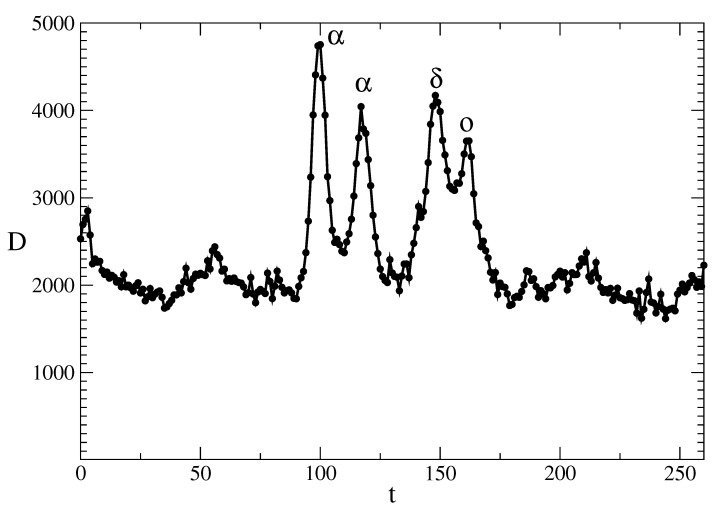 Figure 2
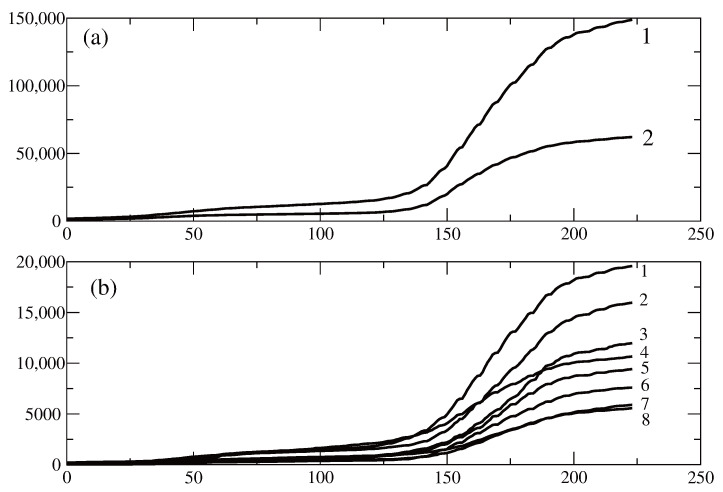 Figure 3
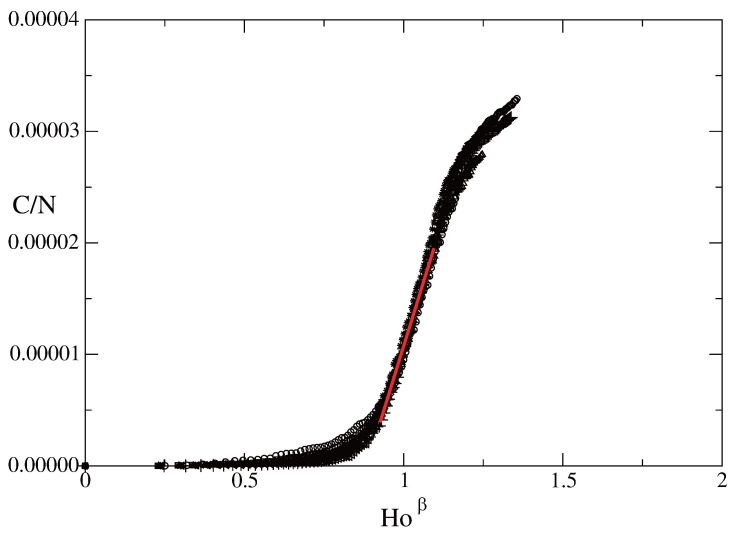 Figure 4
Peer Reviews
No public reviews on file for this paper yet. If you reviewed it on a platform where reviews are public (OpenReview, ICLR, NeurIPS, ICML), you can paste yours below so the community can read it here.
Videos
No videos yet. Explain this paper in a talk, walkthrough, or lecture? Add one.
Taxonomy
TopicsCOVID-19 epidemiological studies · Complex Network Analysis Techniques · Complex Systems and Time Series Analysis