Updating “Stroke 1‐2‐0” by Extending Recognition to Posterior‐Circulation Stroke and Reinforcing Rapid Action in China
Jing Zhao, Qiuhong Ji, Xunming Ji, Renyu Liu

TL;DR
This paper updates a Chinese stroke recognition mnemonic to include more symptoms and emphasize quick action.
Contribution
The paper introduces an enhanced version of the 'Stroke 1-2-0' mnemonic with added symptoms and repetition for better recall.
Findings
Adding visual impairment and imbalance improves detection of posterior-circulation strokes.
Repetition in the mnemonic may enhance recall and reinforce the need for immediate action.
Abstract
“Stroke 1‐2‐0” is a Chinese numeric mnemonic linking face drooping, arm weakness, and speech difficulty to calling emergency services (1‐2‐0). We propose an enhanced repeated version—“Stroke 1‐2‐0, Stroke 1‐2‐0”—that adds visual impairment and imbalance to better detect posterior‐circulation strokes, while repetition may boost recall and stresses zero delay in seeking help.
Genes, proteins, chemicals, diseases, species, mutations and cell lines named across the full text — each resolved to its canonical identifier and authoritative record.
Click any figure to enlarge with its caption.
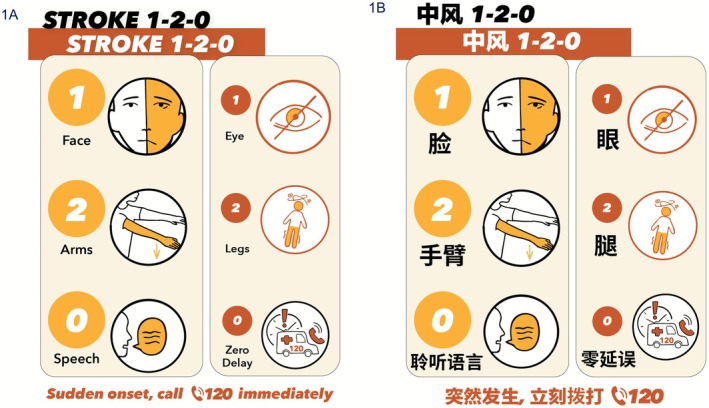 Figure 1
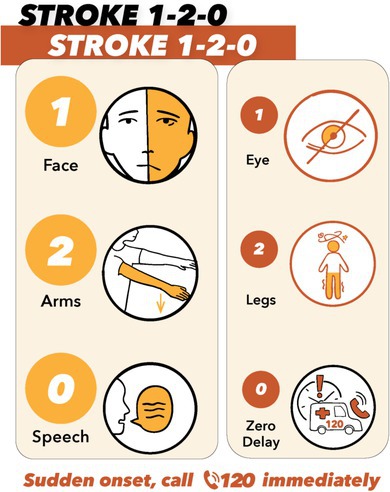 Figure 2
- —Penn Global at the University of Pennsylvania
Peer Reviews
No public reviews on file for this paper yet. If you reviewed it on a platform where reviews are public (OpenReview, ICLR, NeurIPS, ICML), you can paste yours below so the community can read it here.
Videos
No videos yet. Explain this paper in a talk, walkthrough, or lecture? Add one.
Taxonomy
TopicsStroke Rehabilitation and Recovery · Neurobiology of Language and Bilingualism · EEG and Brain-Computer Interfaces
International evidence consistently shows persistent global deficits in stroke awareness and timely action, with many people unable to recognize stroke symptoms or intending to use Emergency Medical Service (EMS) even in high‐income settings. Recent works confirm that recognition of classic symptoms is low to moderate worldwide, and intended responses often remain inappropriate [1, 2, 3]. These gaps are worsened outside English‐speaking regions, where mnemonics such as FAST are difficult to translate with limited linguistic mapping to non‐alphabet‐based languages [4, 5]. Such challenges directly motivated the development of numerical, language‐neutral tools [5, 6]. In 2016, we introduced Stroke 1‐2‐0 as a culturally attuned, number‐based mnemonic for stroke recognition and action in China, where 1‐2‐0 is the emergency medical service (EMS) phone number [5]. In the Stroke 1‐2‐0 system, “1” prompts checking for an uneven face, “2” for weakness in two arms, and “0” for unclear speech—each triggering a call to 1‐2‐0 [5]. The direct linkage of stroke signs and symptoms allowed quick action to call 1‐2‐0.
The program has demonstrated strong public‐health value. A large community study in Shanghai showed significantly reduced prehospital delays, and middle‐school students were able to learn and pass the mnemonic to family members [7, 8]. The effectiveness of Stroke 1‐2‐0 is also demonstrated in primary school students in China [9]. The program has influenced the culture and relevant guidelines to improve stroke care in China [10]. Some proposed a new Stroke 1‐2‐0 based strategy to improve rapid identification and action [11].
Despite the success, Stroke1‐2‐0—like FAST—misses many posterior‐circulation strokes (PCS), which frequently present with a sudden visual disturbance (e.g., monocular or hemifield loss, diplopia) and acute imbalance/dizziness with gait ataxia [12]. These “non‐FAST” symptoms contribute to delayed EMS activation and prolonged door‐to‐needle times. Although BE‐FAST adds “Balance” and “Eye” symptoms, it remains English letter‐based [13].
To address this, this conceptual editorial commentary proposes strengthening the original Stroke 1‐2‐0 by repeating the sequence. The first “1‐2‐0” remains unchanged; the second focuses on PCS:
- 1—One eye or 1 pair of eyes: sudden blurred vision or vision loss It is important to emphasize that multiple visual symptoms may occur and can involve one eye or both eyes.
- 2—Two legs: imbalance or inability to stand steadily.
- 0—Zero delay: call 1‐2‐0 immediately.
A new cartoon (Figure 1) visually distinguishes anterior‐ and posterior‐circulation stroke signs while maintaining a unified teaching script. Although the meanings of “1,” “2,” and “0” differ slightly across the two lines, the overlap in anatomy and behavior reduces potential confusion. For the public, the elements can be taught as a single cue set: ‘1’ for an uneven face or vision problems; ‘2’ for checking two arms for arm weakness or two legs for inability to stand steadily; and ‘0’ for unclear speech or zero delay—call 1‐2‐0 immediately.
This update offers three major benefits: it strengthens recall, expands recognition to PCS, and reinforces stroke action awareness. (1) It reinforces the well‐accepted Stroke 1‐2‐0 program and enhances recall through a simple echo (“Stroke 1‐2‐0, Stroke 1‐2‐0”), Public campaigns should present the update as “the same, then more”—not a replacement, but an augmentation; (2) it expands coverage beyond previous Stroke 1‐2‐0 signs to include key PCS symptoms, and (3) it improves the stroke action awareness—dial 1‐2‐0 immediately when a stroke sign or symptom is spotted. This preserves the recognition speed and cultural resonance of the original number‐based design while broadening sensitivity to strokes that otherwise risk being overlooked. This also aligns well with our recent call to improve stroke action awareness, not just to improve the understanding or knowledge of stroke signs and symptoms by repeating the action of calling 1‐2‐0 after spotting a potential stroke [14].
To address the need for a structured evaluation framework, we outline a staged validation and implementation pathway (Table 1). We propose beginning with a streamlined expert‐acceptance evaluation (a single combined survey with targeted mini‐vignettes) followed by refinement to ensure clarity, safety, action‐specificity (“call 1‐2‐0 now”). Contingent on meeting pre‐set thresholds, we will then conduct a public acceptance test including assessing comprehension, recall, and intention to call 1‐2‐0. Only strategies that pass both the expert and public acceptance phases will be advanced to broaden public education. Throughout, we will engage various professionals (neurology, emergency medicine, EMS/dispatch, nursing, public health, and campaign experts, stroke coordinators, and media partners), seek alignment and support from relevant policymakers, involve stroke survivors, their family members, and community members for survey and workshop design to ensure consistent messaging, sustainable implementation, and rapid scale‐up.
To ensure sustainable implementation, we propose a multi‐city, stepped‐wedge roll‐out comparing pre‐ vs. post‐ assessment in regions adopting the updated messaging. Primary assessment may include onset‐to‐call time, EMS usage, onset‐to‐door and door‐to‐needle/door‐to‐reperfusion times, and the proportion of PCS among EMS‐identified stroke alerts. Process measures should capture campaign reach, dispatch adherence to updated PCS prompts, and ED triage metrics. Prior community interventions built around the original Stroke 1‐2‐0 have shown associations with shorter delays and improved ambulance usage [8]. Promotion strategies may involve school‐based curricula, targeted social media campaigns, partnerships with community health centers, and alignment with national stroke‐awareness programs. Potential indicators of effectiveness include decreased onset‐to‐call times, higher EMS activation rates, and improved public awareness of posterior‐circulation stroke signs.
“Stroke 1‐2‐0, Stroke 1‐2‐0” (中风1‐2‐0, 中风1‐2‐0) preserves the strengths of our original number‐based stroke mnemonic while extending recognition to posterior‐circulation signs. By keeping the first line unchanged and dedicating the second to sudden onset of blurred vision and/or vision loss or two‐leg imbalance due to dizziness, the update offers an easy‐to‐teach, easy to remember enhancement aligned with the goal of faster EMS activation for every stroke. This commentary does not assess behavioral effectiveness, which will be addressed in future studies guided by the proposed framework.
Funding
This work was supported by Penn Global at the University of Pennsylvania, 0000000115.
Conflicts of Interest
The authors declare no conflicts of interest.
The reference list from the paper itself. Each links out to its DOI / PubMed record.
- 1J. Bosch , R. Lotlikar , R. Melifonwu , et al., “Prehospital Stroke Care in Low‐ and Middle‐Income Countries: A World Stroke Organization (WSO) Scientific Statement,” International Journal of Stroke 20 (2025): 918–927, 10.1177/17474930251351867.40495741 PMC 12446713 · doi ↗ · pubmed ↗
- 2A. G. Rudd , J. Zhao , G. Ford , et al., “Results of an International Survey on the Status of Prehospital Care,” International Journal of Stroke 18 (2023): 1084–1091, 10.1177/17474930231177204.37154607 PMC 10614170 · doi ↗ · pubmed ↗
- 3T. Vatsalis , D. Papadopoulos , V. Georgousopoulou , P. Bostantzis , and J. Rudolf , “Global Awareness and Response to Early Symptoms of Acute Stroke: A Systematic Literature Review,” Cureus 17 (2025): e 78420, 10.7759/cureus.78420.39916816 PMC 11802177 · doi ↗ · pubmed ↗
- 4J. M. Marquez‐Romero , K. I. Sanchez‐Ramirez , C. D. Perez‐Malagon , et al., “Efficacy of Five Strategies to Improve Stroke Action Awareness in Spanish‐Speaking Adults: A Randomized Comparison,” International Journal of Stroke (2025): 17474930251378229, 10.1177/17474930251378229.40884082 PMC 12932688 · doi ↗ · pubmed ↗
- 5J. Zhao and R. Liu , “Stroke 1‐2‐0: A Rapid Response Programme for Stroke in China,” Lancet Neurology 16 (2017): 27–28, 10.1016/S 1474-4422(16)30283-6.PMC 557882928029517 · doi ↗ · pubmed ↗
- 6J. Zhao , M. F. Eckenhoff , W. Z. Sun , and R. Liu , “Stroke 112: A Universal Stroke Awareness Program to Reduce Language and Response Barriers,” Stroke 49 (2018): 1766–1769, 10.1161/STROKEAHA.118.021729.29925649 PMC 6034704 · doi ↗ · pubmed ↗
- 7X. Li , Y. Liu , A. Vrudhula , R. Liu , and J. Zhao , “Middle School Students Effectively Improve Stroke Knowledge and Pass Them to Family Members in China Using Stroke 1‐2‐0,” Frontiers in Neurology 11 (2020): 203, 10.3389/fneur.2020.00203.32322233 PMC 7156590 · doi ↗ · pubmed ↗
- 8J. Yuan , M. Li , Y. Liu , et al., “Analysis of Time to the Hospital and Ambulance Use Following a Stroke Community Education Intervention in China,” JAMA Network Open 5 (2022): e 2212674, 10.1001/jamanetworkopen.2022.12674.35579896 PMC 9115614 · doi ↗ · pubmed ↗