Seasonal variation in Aspergillus abundance in captive penguin burrow sands and its implication for aspergillosis risk in Japan
Shiori Takanobu, Yuri Araki, Rie Nitta, Hideaki Shindo, Naoya Matsumoto, Megumi Itoh, Kazutaka Yamada, Takahito Toyotome

TL;DR
This study found that Aspergillus fungi, which can cause disease in penguins, peak during warmer months in Japan, suggesting temperature monitoring is important for preventing aspergillosis.
Contribution
The study identifies seasonal patterns of Aspergillus spp. in penguin burrows in Japan and links them to temperature, offering insights for disease prevention.
Findings
Aspergillus spp. positivity peaked from July to October in both study years.
Average temperature showed a strong positive correlation with fungal positivity (r = 0.781, p < 0.01).
Multiple pathogenic Aspergillus sections were identified, including Fumigati, Nigri, Flavi, and Terrei.
Abstract
Aspergillosis is a major fungal disease in penguins. However, seasonal variation of Aspergillus spp. in burrow sands and its association with meteorological factors remain poorly characterized, particularly under Japan’s climatic conditions. This study aimed to examine seasonal changes in Aspergillus spp. abundance in Humboldt penguin burrows and test whether temperature and other environmental factors correlated with fungal positivity. From June 2023 to October 2024, 158 sand samples were collected from burrows and surrounding areas at an outdoor Humboldt penguin (Spheniscus humboldti) facility in Shimonoseki, Japan. Fungal colonies were cultured and identified morphologically and by sequencing. Aspergillus spp. positivity peaked from July to October in both years. Average temperature showed strong positive correlation with fungal positivity (r = 0.781, p < 0.01), while other…
Genes, proteins, chemicals, diseases, species, mutations and cell lines named across the full text — each resolved to its canonical identifier and authoritative record.
Click any figure to enlarge with its caption.
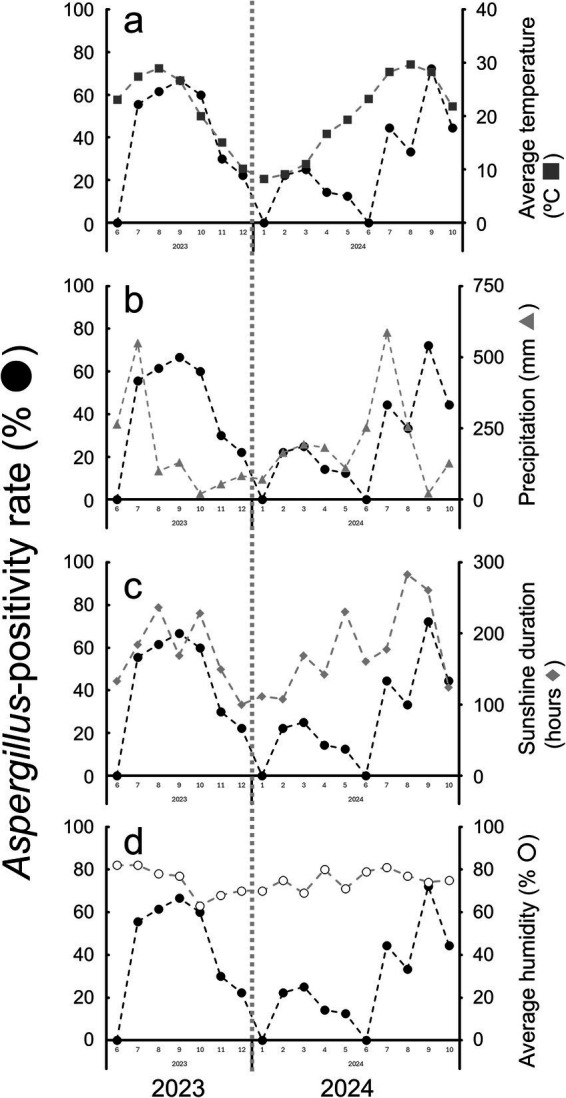 Figure 1
 Figure 2
 Figure 3
 Figure 4
 Figure 5
 Figure 6
Peer Reviews
No public reviews on file for this paper yet. If you reviewed it on a platform where reviews are public (OpenReview, ICLR, NeurIPS, ICML), you can paste yours below so the community can read it here.
Videos
No videos yet. Explain this paper in a talk, walkthrough, or lecture? Add one.
Taxonomy
TopicsNail Diseases and Treatments · Antifungal resistance and susceptibility · Infectious Diseases and Mycology