Characterization of the Direct and Indirect Inhibition of Apoptosis by Full‐Length Recombinant Bcl‐xL Monomers
Christina Elsner, Ludovica M. Epasto, Adeline Cieren, Dominik Gendreizig, Svetlana Kucher, Daniel Roderer, Enrica Bordignon

TL;DR
This paper presents a method to produce full-length Bcl-xL proteins that can inhibit cell death by acting on membranes and in solution.
Contribution
A high-yield protocol for obtaining monomeric full-length Bcl-xL that retains its functional properties in apoptosis inhibition.
Findings
Monomeric Bcl-xL can inhibit membrane permeabilization both directly and indirectly.
The protocol allows Bcl-xL to shuttle between membrane and aqueous environments.
The method uses a minimal Bcl-2 interactome with Bcl-xL, cBid, and Bax for in vitro and in organelle assays.
Abstract
The Bcl‐2 protein Bcl‐xL is an inhibitor of intrinsic apoptosis which either directly inhibits the pore‐forming Bcl‐2 proteins, like Bax or Bak, or indirectly inhibits pore formation by sequestering the pro‐apoptotic BH3‐only activators. The structural basis of the inhibition of pore formation in the outer mitochondrial membrane is still largely unknown due to the lack of atomic resolution structures of the relevant inhibitory complexes at the membrane. Herein, a protocol to obtain high‐yield recombinant monomeric full‐length Bcl‐xL proteins is presented. The monomeric Bcl‐xL retains the ability to shuttle between membrane and aqueous environments and can successfully inhibit Bcl‐2‐induced membrane permeabilization via both modes of action, as proven by in vitro and in organelle assays with a minimal Bcl‐2 interactome constituted by Bcl‐xL, cBid, and Bax. Purification of full‐length…
Genes, proteins, chemicals, diseases, species, mutations and cell lines named across the full text — each resolved to its canonical identifier and authoritative record.
Click any figure to enlarge with its caption.
 Figure 1
 Figure 2
 Figure 3
 Figure 4
 Figure 5
 Figure 6
 Figure 7
 Figure 8
 Figure 9
 Figure 10
 Figure 11
 Figure 12
 Figure 13
 Figure 14
 Figure 15
 Figure 16
 Figure 17
 Figure 18
 Figure 19
 Figure 20
 Figure 21
 Figure 22
 Figure 23
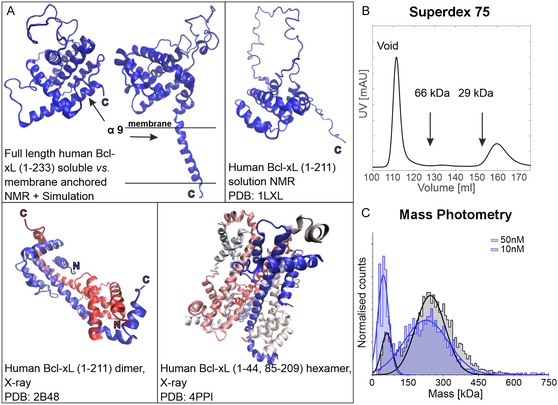 Figure 24
Peer Reviews
No public reviews on file for this paper yet. If you reviewed it on a platform where reviews are public (OpenReview, ICLR, NeurIPS, ICML), you can paste yours below so the community can read it here.
Videos
No videos yet. Explain this paper in a talk, walkthrough, or lecture? Add one.
Taxonomy
TopicsCell death mechanisms and regulation · Mitochondrial Function and Pathology · Molecular Sensors and Ion Detection