Immunological and virological questions for H5N1 pandemic emergence
Mario A Peña-Hernández, Miyu Moriyama

TL;DR
This paper reviews the spread and characteristics of H5N1 influenza viruses and identifies research needed to prevent future pandemics.
Contribution
The paper highlights virological and immunological factors influencing H5N1 transmission and outlines key research priorities.
Findings
H5N1 influenza viruses have expanded geographically and host range since the 1990s.
Molecular barriers limit H5N1 transmission among humans.
Future research is needed to mitigate the H5N1 panzootic and prevent pandemics.
Abstract
Zoonotic spillover of influenza A viruses into humans has repeatedly triggered pandemics throughout history. Since their emergence in the 1990s, H5N1 influenza viruses have significantly expanded their geographical range and host species, raising global concern about the potential for sustained human-to-human transmission. In this review, we examine the virological characteristics of currently circulating H5N1 strains, key molecular barriers limiting their spread among humans, and critical areas of future research to mitigate the ongoing H5N1 panzootic and prevent future pandemics.
Genes, proteins, chemicals, diseases, species, mutations and cell lines named across the full text — each resolved to its canonical identifier and authoritative record.
Click any figure to enlarge with its caption.
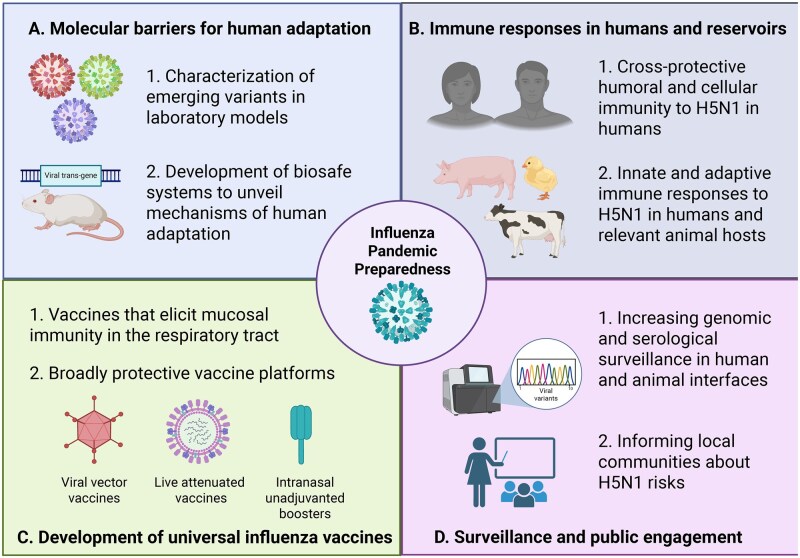 Figure 1
 Figure 2
Peer Reviews
No public reviews on file for this paper yet. If you reviewed it on a platform where reviews are public (OpenReview, ICLR, NeurIPS, ICML), you can paste yours below so the community can read it here.
Videos
No videos yet. Explain this paper in a talk, walkthrough, or lecture? Add one.
Taxonomy
TopicsInfluenza Virus Research Studies · Respiratory viral infections research · Poxvirus research and outbreaks