Five-year disease-modifying therapeutic experience of 102 Chinese paediatric 5q-spinal muscular atrophy: a retrospective analysis
Minyan Jiang, Cuili Liang, Yani Zhang, Kelu Zheng, Kaishou Xu, Lu He, Jianping Tao, Weizhe Wu, Ruidan Zheng, Min Rao, Wen Zhang, Wenhao Zhou, Li Liu

TL;DR
A study of 102 Chinese children with SMA found that disease-modifying therapies improved motor function and survival, but also highlighted complications and the importance of early treatment.
Contribution
This study provides long-term clinical outcomes of disease-modifying therapies for SMA in a large pediatric cohort in China.
Findings
Patients showed significant motor function gains over five years of treatment.
Type 1 patients experienced weight loss and compromised growth after treatment.
Early initiation of therapy was linked to better outcomes and fewer complications.
Abstract
5q-spinal muscular atrophy (SMA) is a fatal autosomal recessive disease characterized by the progressive muscle weakness and atrophy. In this retrospective study, we described the long-term clinical outcomes of novel disease-modifying therapies (DMTs) for 5q-spinal muscular atrophy, drawing on experience from southern China. This is a single-centre large cohort which enrolled 102 paediatric patients confirmed with 5q-spinal muscular atrophy at Guangzhou Women and Children’s Medical Center from 2019 to 2024. One hundred and two patients were included, 24 were classified as SMA type 1, 56 with type 2 and 22 with type 3. One hundred per cent of the patients received nusinersen, with 31 (30.3%) patients starting risdiplam and 2 patients transitioning to zolgensma therapy. Over the 5-year treatment and follow-up period (2019–24), the survival rate reached 97.08%. One child with SMA type 1…
Genes, proteins, chemicals, diseases, species, mutations and cell lines named across the full text — each resolved to its canonical identifier and authoritative record.
Click any figure to enlarge with its caption.
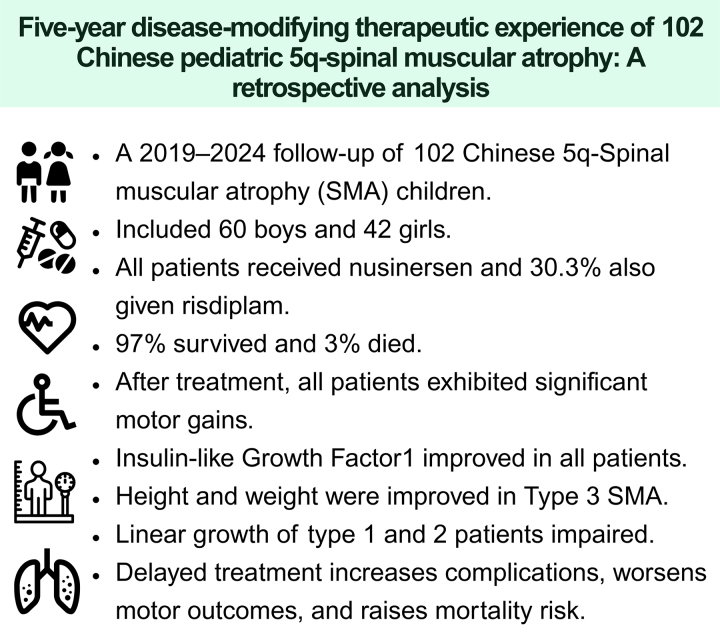 Figure 1
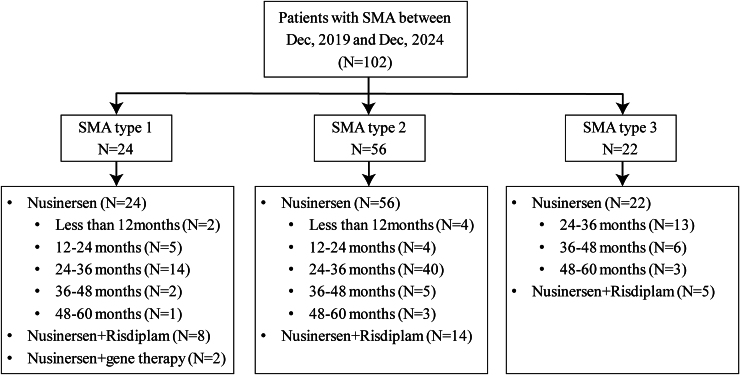 Figure 2
Peer Reviews
No public reviews on file for this paper yet. If you reviewed it on a platform where reviews are public (OpenReview, ICLR, NeurIPS, ICML), you can paste yours below so the community can read it here.
Videos
No videos yet. Explain this paper in a talk, walkthrough, or lecture? Add one.
Taxonomy
TopicsNeurogenetic and Muscular Disorders Research · Muscle Physiology and Disorders · Spinal Dysraphism and Malformations