Routine admission urinalysis has low clinical utility in psychiatric hospitalizations
Tri Pham, Devanshi Patel, Ana Berce, Alice Bewley, Sena Sayood

TL;DR
Routine urinalysis during psychiatric hospitalizations rarely detects urinary tract infections and often leads to unnecessary antibiotic use.
Contribution
This study quantifies the low clinical value and high rate of inappropriate antibiotic prescriptions from routine admission urinalysis in psychiatric settings.
Findings
Admission urinalyses identified urinary tract infections in only 1.7% of psychiatric patients.
71.3% of antibiotic prescriptions based on urinalysis results were inappropriate.
Inappropriate prescriptions were more common in older patients, females, those with positive cultures, and specific psychiatric diagnoses.
Abstract
We examined the diagnostic utility of urinalyses (UAs) in psychiatric admissions. Admission UAs led to diagnosis of clinical urinary tract infections in 1.7% of cases. Among those treated with antibiotics, inappropriate prescriptions occurred in 71.3% of cases, with increased odds in older age, female sex, positive cultures, and certain psychiatric diagnoses.
Genes, proteins, chemicals, diseases, species, mutations and cell lines named across the full text — each resolved to its canonical identifier and authoritative record.
Click any figure to enlarge with its caption.
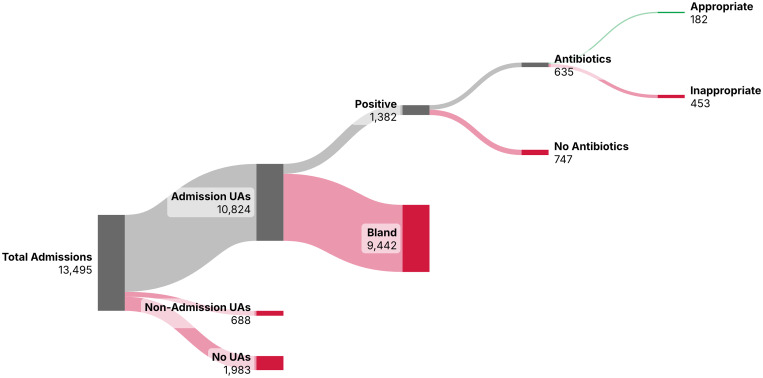 Figure 1
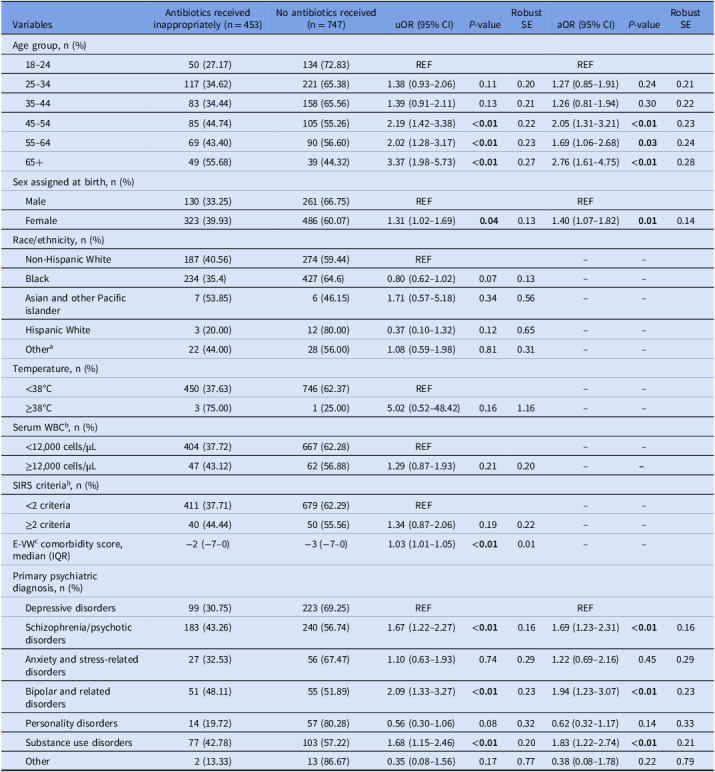 Figure 2
Peer Reviews
No public reviews on file for this paper yet. If you reviewed it on a platform where reviews are public (OpenReview, ICLR, NeurIPS, ICML), you can paste yours below so the community can read it here.
Videos
No videos yet. Explain this paper in a talk, walkthrough, or lecture? Add one.
Taxonomy
TopicsUrinary Tract Infections Management · Schizophrenia research and treatment · Psychopathy, Forensic Psychiatry, Sexual Offending