Assessing potential added benefits of trauma-focused content to a guided low-intensity psychoeducational intervention for perinatal women: A propensity score-matched analysis of a nonrandomized trial
Laura Miller-Graff, Jessica Carney, Elsa Padilla Cancino, Liliana Yataco Romero, Marta Rondon, Leydi Moran, Leydi Moran, Leydi Moran

TL;DR
This study explores whether adding trauma-focused content to a digital mental health program for pregnant women in Peru improves outcomes like depression and resilience.
Contribution
The study introduces a trauma-focused enhancement to a low-intensity digital intervention and evaluates its potential added benefits using propensity score matching.
Findings
Intervention uptake was high, with 77% of women participating in all sessions.
Trauma-focused content showed slight advantages in reducing depression symptoms and improving multisystem resilience.
Intimate partner violence had strong negative effects on mental health and parenting outcomes.
Abstract
Brief, low-intensity interventions may hold untapped promise for bolstering maternal health in low-resource contexts. The current study used propensity score matching (PSM) to evaluate uptake and differential effectiveness of two low-intensity digital perinatal health (PH) support programs in Lima, Peru. Pregnant women (N = 251) were assigned to one of two conditions (PH vs. trauma-focused PH [TF-PH]) and received weekly psychoeducational content via WhatsApp from a lay paraprofessional for 5 weeks. Conditions were not randomly assigned; PSM was used to improve causal inference of the condition. Women were interviewed before participation (T1), immediately following treatment (T2) and at 3 (T3) and 12 months postpartum (T4). Intimate partner violence had strong negative effects on women’s mental health, multisystem resilience and parenting, and single mothers reported higher levels of…
Genes, proteins, chemicals, diseases, species, mutations and cell lines named across the full text — each resolved to its canonical identifier and authoritative record.
Click any figure to enlarge with its caption.
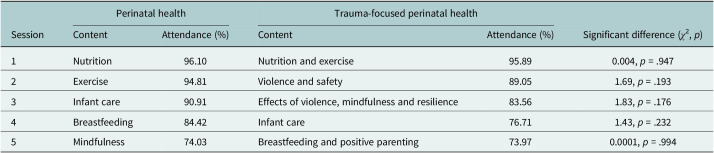 Figure 1
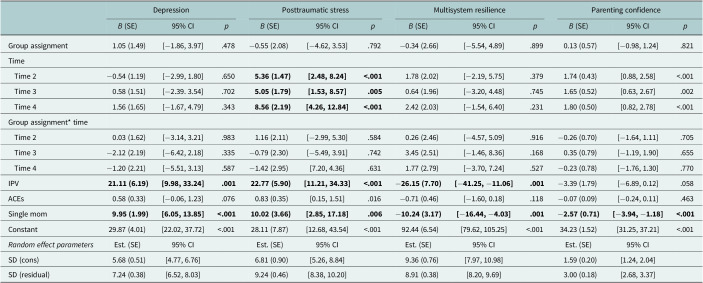 Figure 2
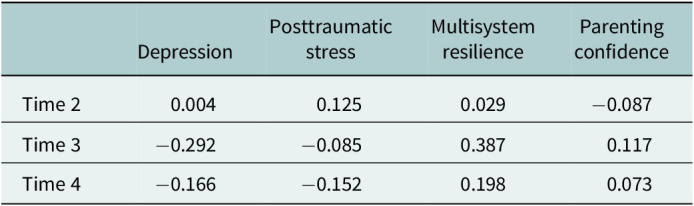 Figure 3
Peer Reviews
No public reviews on file for this paper yet. If you reviewed it on a platform where reviews are public (OpenReview, ICLR, NeurIPS, ICML), you can paste yours below so the community can read it here.
Videos
No videos yet. Explain this paper in a talk, walkthrough, or lecture? Add one.
Taxonomy
TopicsMaternal Mental Health During Pregnancy and Postpartum · Global Maternal and Child Health · Child Abuse and Trauma