Implementation of an interruptive electronic health record alert improves optimal antibiotic prescribing in ambulatory patients with acute bacterial sinusitis: a quasi-experiment
Stormmy R. Boettcher, Anita B. Shallal, Adrienne Vaught, Steven T. Fried, John R. Craig, Brian M. Church, Rachel M. Kenney, Susan L. Davis, Michael P. Veve

TL;DR
A new alert in electronic health records helped doctors prescribe better antibiotics for sinusitis patients.
Contribution
An interruptive alert system was implemented to improve antibiotic prescribing for acute bacterial sinusitis.
Findings
Optimal antibiotic prescribing increased from 7% to 30% after the alert implementation.
The alert significantly improved antibiotic selection and duration for sinusitis treatment.
Abstract
Sinusitis is a leading cause for outpatient antibiotics. An interruptive electronic health record alert was implemented to promote optimal antibiotic selection and duration for acute bacterial sinusitis when suboptimal treatment is ordered. After implementation, optimal antibiotic prescribing significantly increased 7% preintervention versus 30% postintervention, (unadjOR, 5.69; 95% CI, 2.36 – 13.72; P < .001).
Genes, proteins, chemicals, diseases, species, mutations and cell lines named across the full text — each resolved to its canonical identifier and authoritative record.
Click any figure to enlarge with its caption.
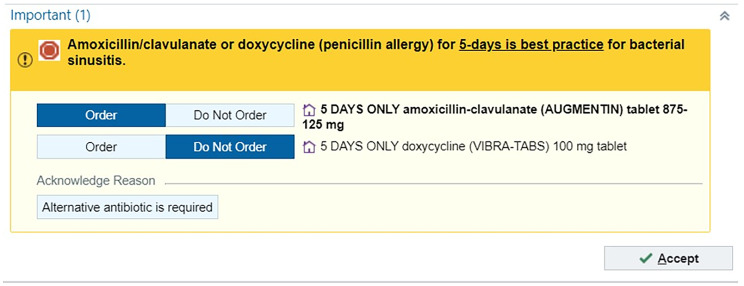 Figure 1
Peer Reviews
No public reviews on file for this paper yet. If you reviewed it on a platform where reviews are public (OpenReview, ICLR, NeurIPS, ICML), you can paste yours below so the community can read it here.
Videos
No videos yet. Explain this paper in a talk, walkthrough, or lecture? Add one.
Taxonomy
TopicsAntibiotic Use and Resistance · Pharmacovigilance and Adverse Drug Reactions · Nosocomial Infections in ICU