Exploring Risk Factors and Neurophysiological Mechanisms Underlying the Development of Chronic Postsurgical Pain After Thoracic Surgery: Protocol for an Observational Feasibility Study
Mustaali Hussain, Stevie Dante Foglia, Ameer Hamoodi, Jinhui Ma, John Agzarian, Christian John Finley, Yaron Shargall, Aimee Jennifer Nelson, Harsha Shanthanna

TL;DR
This study aims to explore risk factors and brain activity patterns that may predict chronic pain after chest surgery, to help develop better prevention strategies.
Contribution
The study introduces a novel approach using brain stimulation and EEG to investigate preoperative neurophysiological predictors of chronic postsurgical pain.
Findings
The study will assess feasibility through recruitment and retention rates.
It will explore preoperative neurophysiological markers linked to chronic pain risk.
Postoperative brain function differences between patients with and without chronic pain will be examined.
Abstract
Chronic postsurgical pain (CPSP) is a debilitating chronic pain condition that particularly impacts patients undergoing thoracic surgery, with incidence rates of up to 50%. The current understanding of risk factors is limited, and preoperative neurophysiological risk factors that may predict the development of CPSP have not yet been explored. Additionally, the specific neural mechanisms underlying the transition to CPSP are not well characterized. As a novel approach, we propose the use of transcranial magnetic stimulation and electroencephalography, along with other patient and surgical factors, to understand the neurophysiological mechanisms underlying the onset of CPSP after thoracic surgery. The primary objective of this study is to evaluate the feasibility of our study design to inform a larger observational cohort study. Secondary objectives include exploring preoperative…
Genes, proteins, chemicals, diseases, species, mutations and cell lines named across the full text — each resolved to its canonical identifier and authoritative record.
Click any figure to enlarge with its caption.
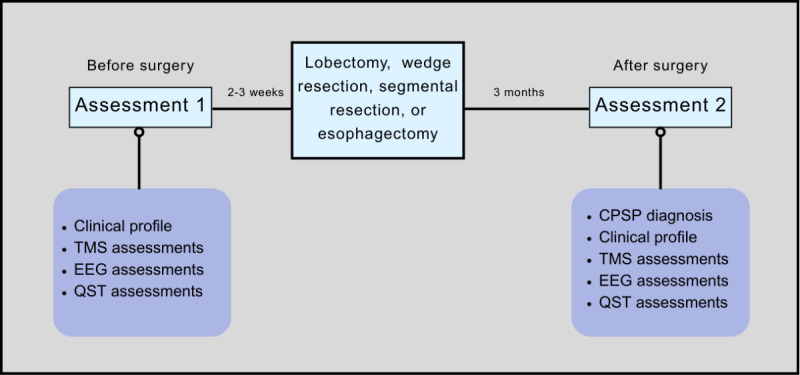 Figure 1
Peer Reviews
No public reviews on file for this paper yet. If you reviewed it on a platform where reviews are public (OpenReview, ICLR, NeurIPS, ICML), you can paste yours below so the community can read it here.
Videos
No videos yet. Explain this paper in a talk, walkthrough, or lecture? Add one.
Taxonomy
TopicsAnesthesia and Pain Management · Cancer, Stress, Anesthesia, and Immune Response · Pain Management and Opioid Use